
Reviewed · GRAFFITI TOURS
East End London Instagrammable Street Art and Graffiti Tour
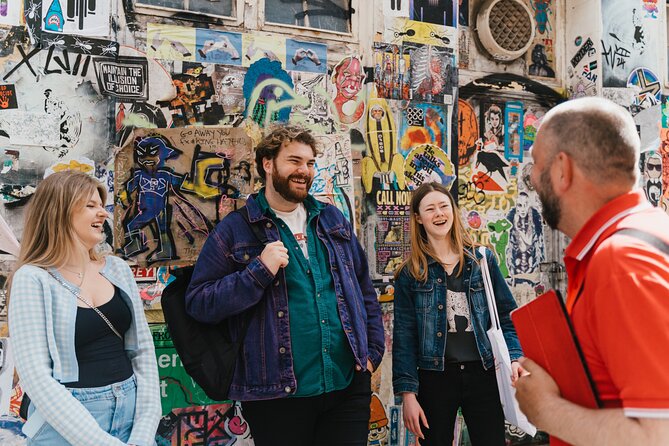
East London’s street art is not arranged behind glass or lined up in a museum. It appears on side streets, yard walls, doors, shutters, and old buildings, often with only a narrow angle from which to see it properly. This two-hour walk takes you from Whitechapel through Brick Lane and Shoreditch, mixing famous names such as Banksy with artists you might otherwise walk straight past.
I like the way the tour explains why the art is there, not just who painted it. I also like the chance to make your own small piece, a playful finish to a walk that takes art seriously without becoming stiff. The main drawback is that street art changes quickly, and some works may be painted over, damaged, or protected behind glass by the time you arrive.
Key points to know before you book
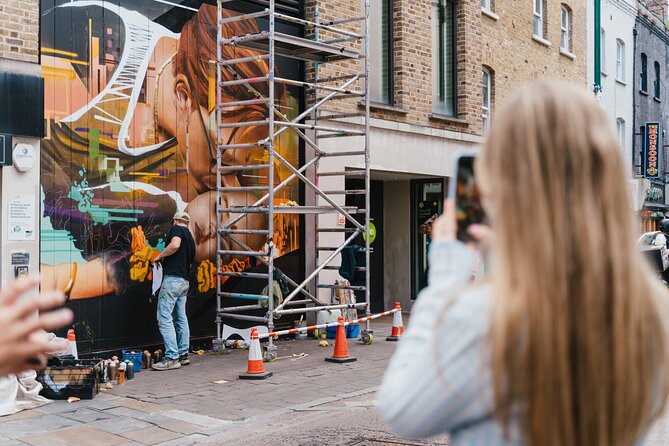
- Banksy and major murals: See preserved Banksy pieces, a huge ROA bird, Martin Ron’s upside-down figure, and work by Stik, Thierry Noir, Ben Eine, and others.
- A changing open-air gallery: Allen Gardens and nearby walls can look different from week to week, so the exact route may shift with the art.
- A real East London story: The walk covers immigration, community identity, graffiti rivalries, art markets, and the difference between street art and graffiti writing.
- Hands-on finish: You get an opportunity to make your own street art rather than only taking photographs.
- Short, central route: The tour starts at 80 Whitechapel High Street at 11 a.m. and usually finishes near Liverpool Street Station.
- Small enough to follow: The maximum group size is 20 people, and the price is $49 per person.
Why this East London walk feels different from a gallery visit
The best part of this tour is the setting. You are not moving from one polished room to another. You are walking through an area where public art competes with shop signs, old brickwork, construction, stickers, doors, parked cars, and everyday city life.
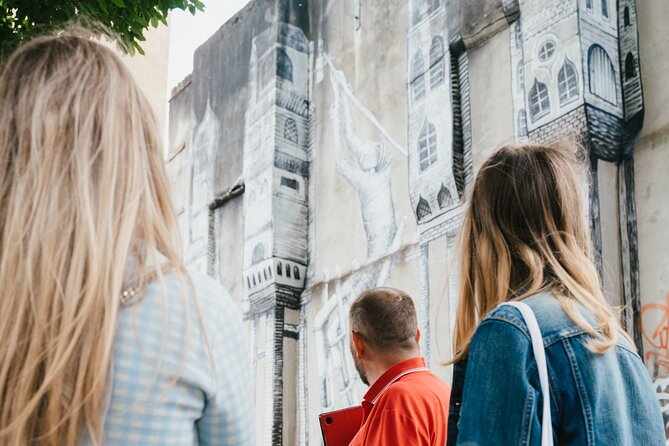
That setting matters because many works were made for a particular wall. Some artists use the shape of a building, a drainpipe, a window, or a broken surface as part of the design. At Hanbury Street, for example, Martin Ron’s upside-down man works with the features of the building itself. The scale is impressive, but so is the technical control.
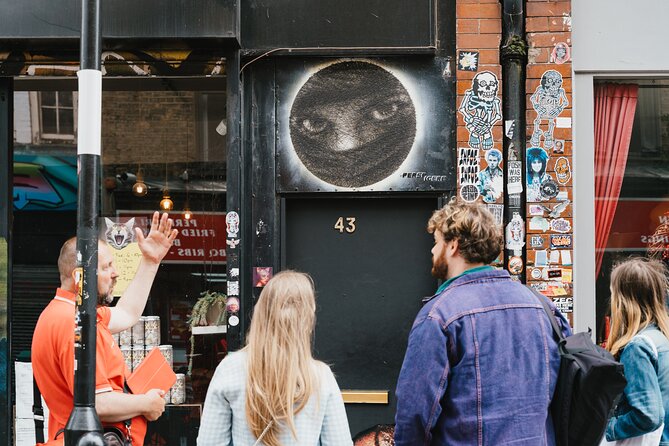
Your guide also gives you a way to read pieces that can seem confusing at first. Graffiti writers may use elaborate letter forms that are nearly impossible to read. The point is not always clear communication. Color, rhythm, scale, and placement can matter just as much as the word itself.
The tour has a 5 out of 5 rating from 16 reviews, with 100 percent recommending it. That is a small sample, so I would not treat it as proof that every person will love every minute. Still, the strongest praise focuses on the exact things the walk is designed to provide: a fun look at London’s contemporary art scene and the cultural story of an unusual neighborhood.
More Graffiti Tours in the UK
- London: Street Art and Graffiti Guided Walking Tour
★ 4.9 · 1,354 reviews - Shoreditch Street Art and Graffiti Tour (Private Group Booking)
★ 5.0 · 108 reviews - ADVANCED GRAFFITI STREET ART TOUR / SHOREDITCH / EAST LONDON
★ 5.0 · 23 reviews
From Heneage Street to Brick Lane, the quieter opening
The meeting point is at 80 Whitechapel High Street. From there, the walk heads toward Heneage Street, where some of the first works are tucked into small backyards and side spaces.
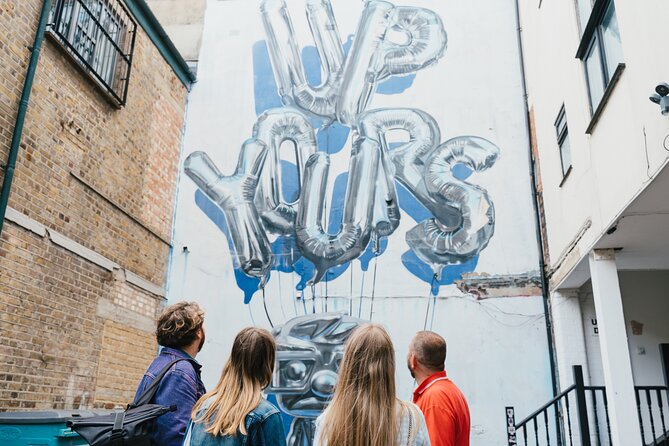
Look for Phlegm’s tall, thin creatures walking on stilts above layers of tags. His figures have a distinctive shape, and the height of the work makes you look up rather than simply scan a wall at eye level. Across the street is a piece by FanakaPan, whose silver helium balloons give his work an instantly recognizable look.
This opening stop sets the tone. You are learning to search, not just follow a main road. The art may be in a yard, around a corner, or partly concealed by the ordinary clutter of the neighborhood. Bring a phone with a wide enough lens if you want to photograph full walls from close range.
Brick Lane brings a different kind of viewing. The guide starts you at a distance, then moves you closer to works by Dan Kitchener and Perspicere painted on doors. These pieces are not enormous, so their details reward a slower look.
That change in scale is useful. The tour is not only a parade of giant murals. Small doors and stickers receive attention too, and you learn that a successful photograph may require moving back, stepping forward, or finding a better angle.
Stickers, community memory, and a wall of birds
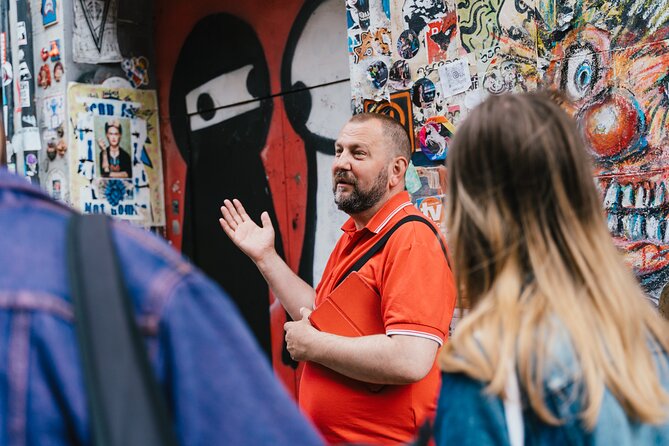
At The Seven Stars, the walk turns into a narrow, dirty yard where stickers take over. This is a good reminder that street art is not limited to spray paint or large brushwork. Stickers can be quick, personal, funny, political, or simply visual marks left by artists who want to claim a tiny patch of public space.
You also get the opportunity to leave a little art of your own. The details of that activity are not specified, so do not expect a full studio workshop. Think of it as a short, informal chance to take part in the same street-level tradition you have been examining.
Princelet Street adds social context. A piece by Stik is dedicated to the Muslim community and reflects the long connection between refugees, immigrants, and this part of East London. The simple figures and strong color scheme make the work easy to recognize, but the important detail is its repeated repainting after being defaced.
That cycle gives the work meaning beyond its appearance. It has become linked to the local community and its willingness to protect a public statement. This is one of the tour’s stronger moments because it connects street art with identity and belonging.
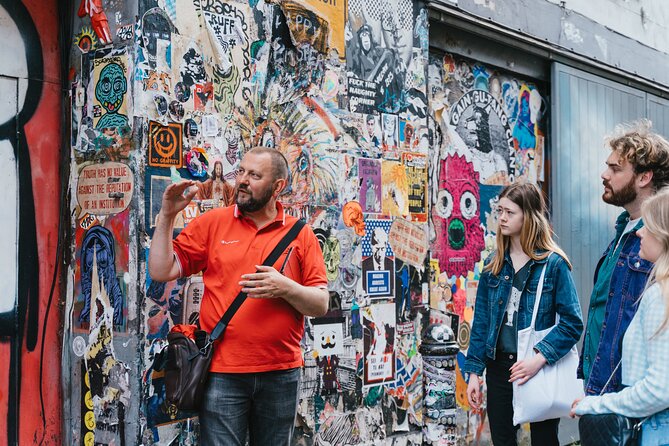
Hanbury Street is one of the busiest art stops in the walk. A large bird by ROA draws you down the side street, but there is much more to see around it: stickers, black and white statements by Wrdsmth, small pieces that may change often, and Martin Ron’s enormous upside-down man.
You may need to choose your photo carefully here. The wall contains several works competing for attention, and a straightforward front-facing shot will not always show how the art uses the building.
Broccoli Lane and the fast-changing walls of Allen Gardens
At Dray Walk, watch for broccoli. Some are realistic, while others appear in bright colors. Artist Adrian Boswell started the recurring motif, which became common enough for part of the street to gain the informal name Broccoli Lane. Boswell later opened a gallery and sold framed broccoli works.
It is an amusing stop, but it also shows how a repeated image can become part of a neighborhood’s visual language. You do not need to know the backstory to enjoy the joke, yet the explanation makes the pieces more memorable.
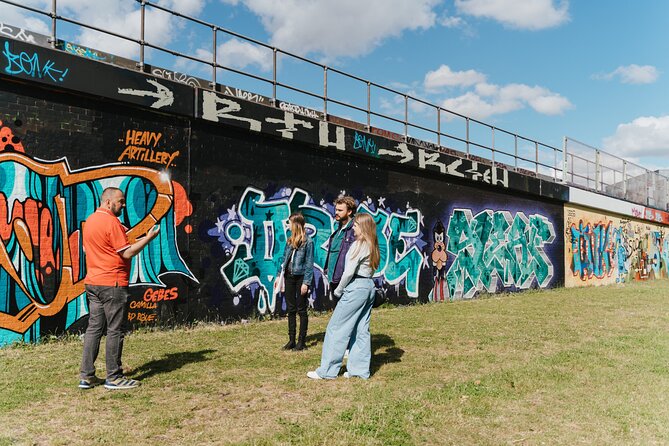
Allen Gardens shifts the focus from individual artists to graffiti writing. The park is surrounded by walls covered with work, much of it changing every few days. You could see a piece that disappears soon after your visit, so take photographs while you can.
Many writers here work mainly with letters. Their pieces may be difficult or impossible to read, but that is part of the challenge. The forms become almost abstract, with color and shape taking priority over a clear message.
This is also one of the tour’s less predictable sections. Because the walls change so quickly, the precise examples described by the guide may not be present. That is not necessarily a weakness, but it means you should book this walk for the explanation and way of seeing the area, not for a fixed checklist of permanent works.
More Graffiti Tours in London:
- London: East End Instagrammable Street Art & Graffiti Tour
★ 4.9 · 22 reviews - 3-Hour Private Tour of East London Graffiti & Street Art
★ 4.5 · 5 reviews - Medellin: Comuna 13 Graffiti Tour, Cable Car & Street Food
★ 4.8 · 9,046 reviews - Wynwood Graffiti Golf Cart Small-Group Tour
★ 5.0 · 1,646 reviews
From collaborative walls to bright modern portraits
As you leave Allen Gardens via Buxton Street, look upward for the number 5. This stop introduces another artist and shows how multiple people can combine their styles on one wall.
Collaborative walls are useful for understanding how street art develops in public. One artist may paint a main figure, another adds lettering, and someone else fills an empty section. The result can look planned, accidental, or both.
Ebor Street marks a shift away from Brick Lane’s older, rougher feel toward a more modern part of the neighborhood. You will find large painted adverts, smaller pieces, and pink portraits by Neon.
Neon’s portraits look as if they were made with a light mist of spray paint. The soft edges may seem simple from a distance, but the placement has to be precise for the faces to appear. This is a good place to compare broad commercial-scale work with smaller personal pieces.
Also on Ebor Street is Ben Eine, whose bold letters are easy to read from far away. His letters may be curved and decorative, sharp and modern, or square and direct. The consistency of the form makes the work accessible even if you know little about graffiti.
I like this part of the route because it gives you an easy comparison. Some graffiti writers make their letters difficult to decipher. Eine makes letters the main event and invites you to notice their shape, spacing, and style.
Banksy, protected art, and the debate around preservation
No East London street art walk would be complete without Banksy. On Rivington Street, the guide takes you to a tucked-away location where older Banksy works appear alongside pieces by lesser-known artists.
The Banksy works are protected behind glass. That creates a useful argument rather than a simple photo opportunity. Is the protection necessary? Does it preserve the art, or change the character of something made for the street? The guide encourages discussion about art markets, changing tastes, and personal opinions.
You may find this stop less raw than the unprotected walls elsewhere. The glass reflects light, and the protected presentation makes the work feel closer to a museum object than a spontaneous street piece. Still, it gives you a chance to think about what happens when temporary public art becomes valuable.
Nearby, a half-seen soldier by Otto Schade appears complete when you stand in the right position. His works often look as if they are made from ribbons. The open shapes may seem empty, but the lines create movement and energy.
This is a good example of why the guide’s placement matters. From the wrong corner, you may see only part of the image. From the right one, the composition comes together.
Rivington Street continues with the colorful heads of Thierry Noir. Noir is known for painting on the Berlin Wall in the 1980s, and he has also left bright characters on London walls. His figures are cheerful and easy to recognize, a welcome change after the dense letter forms and serious community themes earlier in the walk.
A Banksy wall, Shakespeare, and the final graffiti story
At art’otel London Hoxton, part of an old Banksy-painted wall has been removed from its original location and reinstated where the public can see it. The piece is now part of a stylish arts-focused hotel, but it remains outside on the street rather than hidden inside a private room.
This stop raises a question about ownership. Moving street art can preserve it, but it also removes it from the place and conditions that gave it meaning. The tour does not force one answer, which is appropriate for an art form built on argument and change.
At Hewett Street, the route suddenly reaches back to the theater world of William Shakespeare. A statue of Shakespeare sits on a bench marking the site of his Curtain Theatre. You can sit beside him for a photo, then look nearby for a Romeo and Juliet graffiti piece.
The contrast works well. This is not a walk that treats street art as separate from London’s older culture. The area has long been a place where performance, storytelling, newcomers, and public life overlap.
New Inn Broadway brings another large building covered by several artists. Different colors and styles come together in one broad wall, with even a small policeman included among the images. It feels like a final group composition before the route turns toward the City.
The walk finishes with one more story about the Graffiti Wars as you approach Shoreditch High Street and the glass and metal buildings beyond. The exact endpoint can change as the art changes, but you should finish within walking distance of Liverpool Street Station.
What $49 buys you in two hours
At $49 per person, this is not the cheapest way to spend two hours in London. You can walk Brick Lane for free and see plenty of street art without a guide.
The value comes from the interpretation. A guide helps you find works in backyards and narrow yards, recognize artists by style, understand the difference between graffiti writers and street artists, and place individual pieces within local disputes and community stories.
The group is limited to 20 people, which should make it easier to hear the guide and stop at smaller works without creating a large crowd. The tour starts at 11 a.m., a useful time if you want a late morning activity before lunch or an afternoon elsewhere in London.
You receive mobile ticketing and free cancellation up to 24 hours before the start time. If the minimum number is not reached, the provider offers another date or experience, or a full refund. Service animals are allowed, public transportation is nearby, and most people can participate.
The walk lasts about two hours. Wear shoes suited to city pavement, and leave room on your phone for photographs. Because the route is built around changing art, the precise end point can move, so plan to finish near Liverpool Street Station rather than at one exact doorway.
Who should book this street art tour?
I would choose this walk if you want more than a list of famous names. It suits you if you enjoy photography, city neighborhoods, contemporary art, community stories, or the odd little detail that turns an ordinary side street into a destination.
It is also a good fit for first-time visitors who might otherwise see only the main stretch of Brick Lane. The route reaches yards, side streets, parks, and less obvious walls, then connects them to the wider story of East London.
You may want another kind of activity if you need guaranteed access to every named work. Street art is temporary. A mural may be covered, a sticker may vanish, and an outdoor piece may be protected or altered.
The 5 out of 5 rating and 100 percent recommendation rate show strong approval, though only 16 ratings are represented. I would give the tour more weight for its clear strengths: the guide-led discoveries, the Banksy discussion, the graffiti-war stories, and the hands-on art activity.
Book it if you want to understand how East London’s streets became an open-air art space, not simply collect a few colorful photographs. Skip it if you prefer a fixed museum collection or want to explore entirely at your own pace.
FAQ
How long is the East End London street art tour?
The tour lasts approximately two hours.
How much does the tour cost?
The listed price is $49 per person.
What time does the tour begin?
The tour starts at 11:00 a.m.
Where does the tour start?
It starts at 80 Whitechapel High Street, London E1 7QX, United Kingdom.
Where does the tour finish?
The tour usually finishes within walking distance of Liverpool Street Station. The exact endpoint can change depending on the street art route.
Is Banksy included on the tour?
Yes. The route includes older Banksy works on Rivington Street and a section of a Banksy-painted wall displayed at art’otel London Hoxton.
Can I make my own street art?
Yes. The experience includes an opportunity to create your own street art.
What is the cancellation policy?
You can cancel up to 24 hours before the experience for a full refund. Changes or cancellations made less than 24 hours before the start time are not accepted for a refund.
New street art tours in London
- London Street Art Tour of the East End Semi-Private 12ppl Max★ 5.0 · 23 reviews
- The Great Street Art Experience★ 5.0 · 2 reviews
- London Street Art Tour of the East End Exclusive Walking Tour★ 5.0 · 12 reviews
- Shoreditch Street Art Private Photography Tour including Brick Lane★ 5.0 · 5 reviews
- London Unexpected Private Tour – Markets, Street Art & Camden Town★ 5.0 · 2 reviews
- Private Royal London Bike Tour with pub & street art★ 5.0 · 2 reviews
- 3-Hour Private Tour of East London Graffiti & Street Art★ 4.5 · 5 reviews
- London : Shoreditch Street Art Walking Tour★ 3.3 · 4 reviews
Graffiti Tours, side by side.

Comuna 13 Graffiti Tour, Cable Car & Street Food
Read our review →


Brooklyn Graffiti & Street Art Walking Tour in Bushwick
Read our review →
Comuna 13 Tour with Snacks And Your Own Graffiti
Read our review →Lists this wall walk turns up in