
Reviewed · GRAFFITI TOURS
ADVANCED GRAFFITI STREET ART TOUR / SHOREDITCH / EAST LONDON
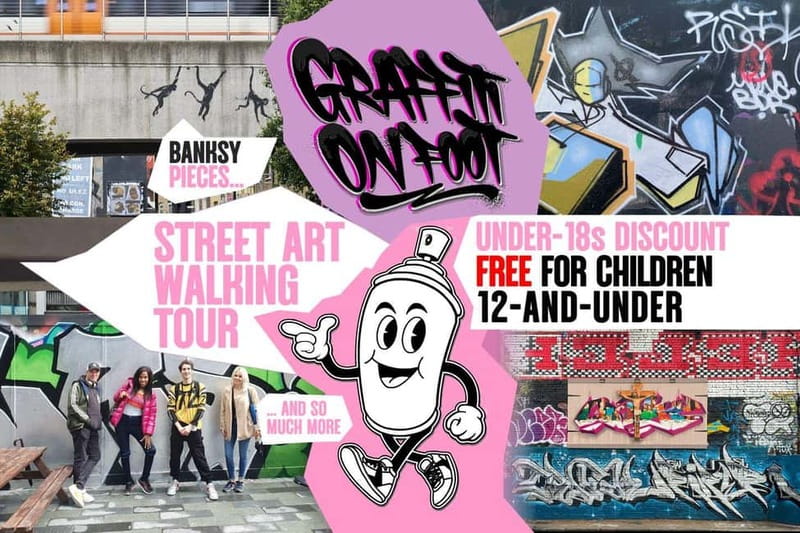
East London’s walls are not just colorful backdrops. They are a running argument about art, ownership, politics, and public space. This 2.5-hour walk with James of Jam Graffiti Tours shows you how to read that argument, from Banksy pieces and Ben Eine lettering to quick tags, large murals, rivalries, and work that may vanish overnight.
I like two things in particular: James explains the codes and slang that make graffiti easier to understand, and the small group size, capped at 15, leaves room for real questions. The main drawback is simple: you are on foot outdoors for 2.5 hours, and the tour is not suitable for wheelchair users.
Key points to know before you book
- At least three Banksy works: You may see a fourth, depending on access and what remains visible.
- James leads the tour: His focus is on context, artistic choices, politics, and the people behind the work.
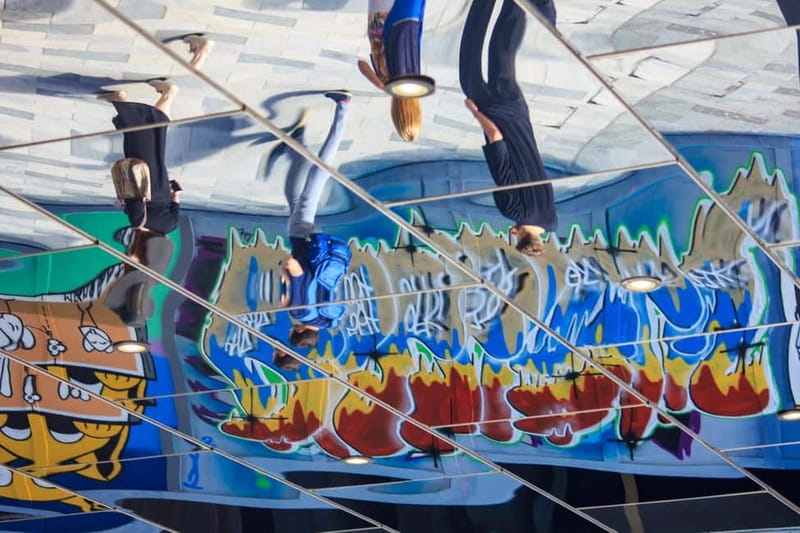
- Shoreditch and Brick Lane: The route covers some of East London’s best-known street art areas, along with less obvious corners.
- Graffiti has its own language: You learn about tags, styles, hierarchy, rivalries, and the difference between graffiti and street art.
- A good family option: Children and teenagers can follow the stories, and the subject gives families plenty to discuss.
- Bring a camera, but be discreet: Photography is encouraged unless artists are working nearby.
Why this Shoreditch walk is more than a Banksy hunt
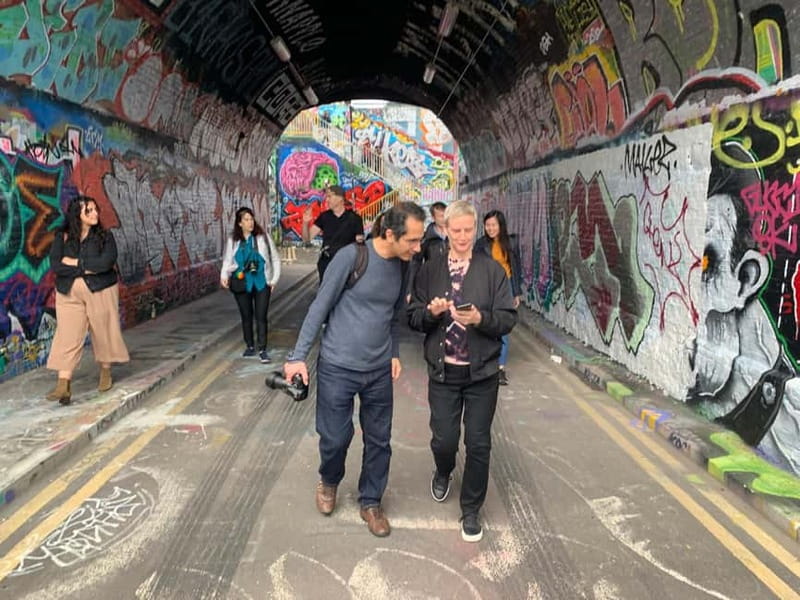
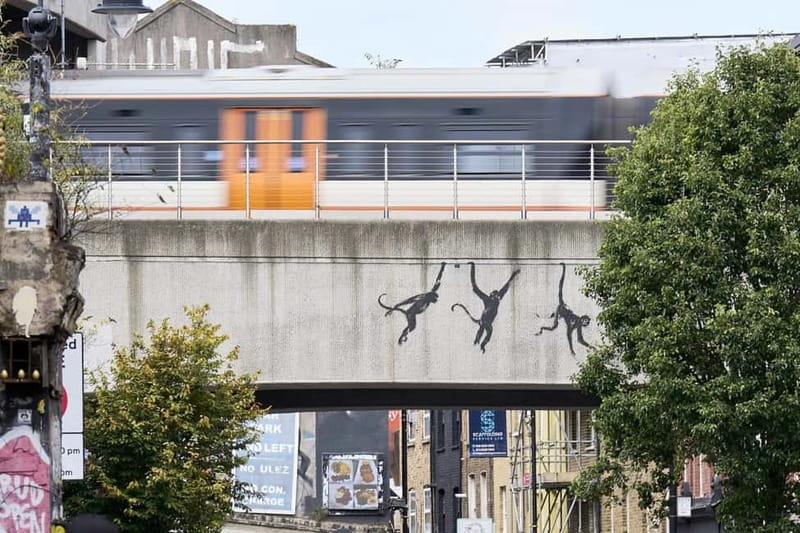
Banksy is the obvious draw, and this tour includes at least three of his works, with a fourth possible depending on access. But the tour works best when you treat Banksy as one chapter in a much larger London story.
James places each piece within the wider world of graffiti and street art. You learn about Banksy’s influences, how his work moved into public debate, and why his fame has caused arguments within the graffiti community. The Team Robbo versus Banksy conflict is part of that story, giving you a sharper sense of the tension between personal style, public fame, and the rules of the street.
I appreciate that the tour does not stop at the familiar name. You also encounter Ben Eine, whose lettering has become a major part of London’s street art identity, along with dozens of other writers and artists. Some pieces may be large and easy to spot. Others may be tucked into an alley, placed high on a wall, or partly covered by newer work.
That changing quality is important. You are not walking through a formal gallery where every artwork has a label and a guaranteed future. The walls change, businesses repaint surfaces, buildings are redeveloped, and artists add new work. The tour gives you a way to understand what you are seeing now, even when it is gone later.
More Graffiti Tours in the UK
- London: Street Art and Graffiti Guided Walking Tour
★ 4.9 · 1,354 reviews - Shoreditch Street Art and Graffiti Tour (Private Group Booking)
★ 5.0 · 108 reviews - London: East End Instagrammable Street Art & Graffiti Tour
★ 4.9 · 22 reviews
Starting with the roots of graffiti in Britain
The opening section provides an introduction to graffiti and street art in the United Kingdom. You learn where graffiti came from, how it developed, and how its purpose changed over time.
The distinction between graffiti and street art matters here. Graffiti often centers on names, lettering, repetition, style, and recognition within a particular community. Street art can use stencils, pasted images, characters, political statements, or large public murals. The boundaries overlap, but they are not identical.
James explains these differences in practical terms. Instead of simply telling you that one piece is good and another is bad, he helps you ask better questions. What is the artist trying to claim? Is the work meant for other writers, the general public, a property owner, or all three? How does the artist use scale, color, placement, and speed?
You also learn that graffiti has codes and a hierarchy. Slang is not decorative language. It reflects how writers identify themselves, respond to one another, and judge skill. Once you hear this explained, a wall covered in marks becomes easier to read. You begin to notice which elements are meant to be seen quickly and which show careful planning.
This part suits beginners especially well. You do not need a background in art, and the tour’s advanced title refers to the depth of the discussion, not a requirement that you already know the subject.
Reading the walls around Shoreditch and Brick Lane
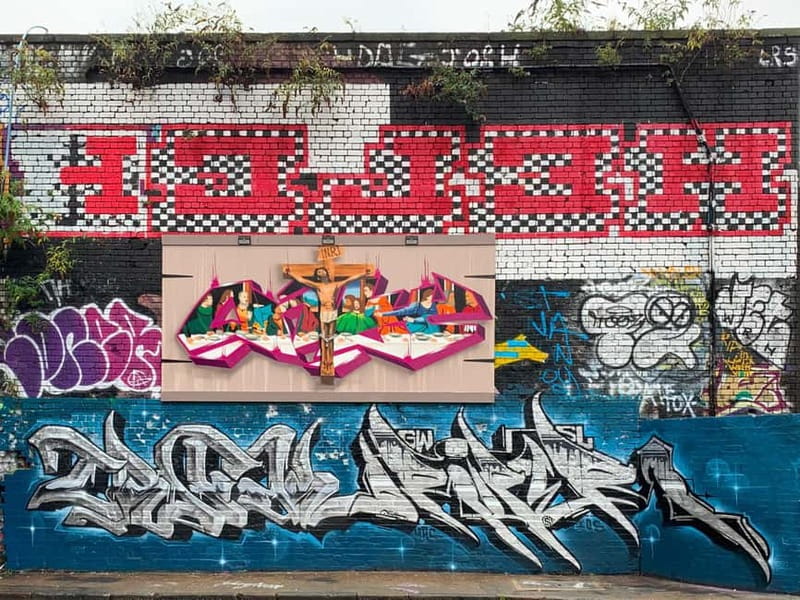
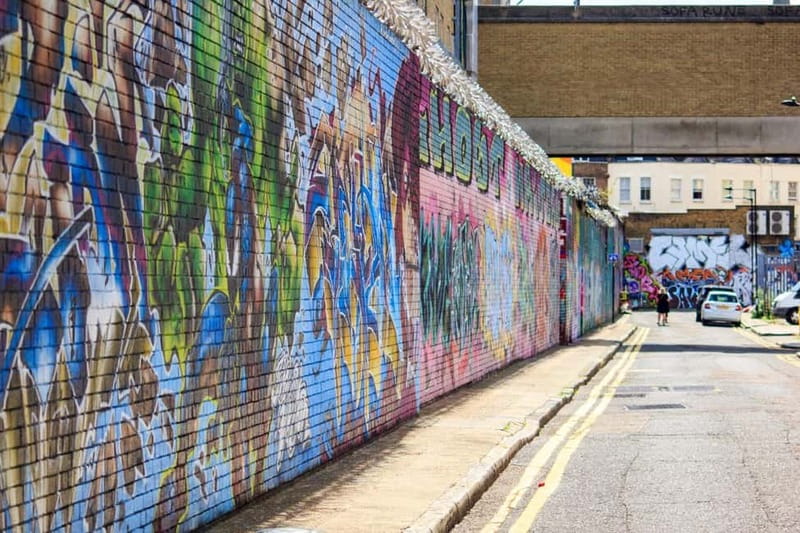
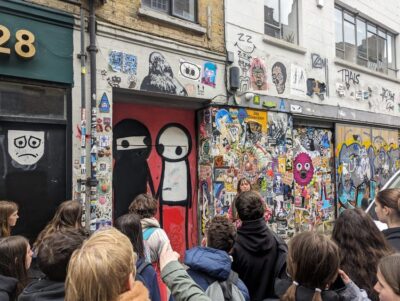
The Shoreditch and Brick Lane area gives the tour plenty to work with. You move through streets and side passages filled with changing layers of paint, paste-ups, stencils, lettering, and large-scale pieces.
The appeal is not only the quantity of art. It is the contrast between different approaches. One artist may use carefully formed letters, another may focus on a quick tag, and another may build a detailed image that comments on society or politics. James helps you compare these choices instead of treating every painted surface as the same kind of work.
Brick Lane is particularly useful because it brings art, commerce, nightlife, food, and redevelopment close together. The walls reflect the neighborhood’s changing identity. Graffiti can challenge gentrification, become part of a business’s image, or be used to make an area more attractive to visitors. Sometimes it does several of these things at once.
That tension gives the walk its edge. Street art can feel rebellious, but it can also help turn a neighborhood into a destination. A wall once treated as vandalism may later be protected, photographed, and used in marketing. The tour discusses how class, politics, gentrification, and social media have shaped this shift.
You will also have plenty of photo opportunities. Still, the best images may not be the most famous ones. Look for small details, overlapping works, old paint showing beneath new paint, and lettering that rewards a closer look. James’s explanations give you a reason to slow down.
Banksy, controversy, and the Team Robbo conflict
The Banksy portion is a major reason to book, but it is not presented as a simple celebrity checklist. You should expect at least three Banksy works, with a fourth possible if access allows. The exact selection can change because public art is exposed to weather, construction, repainting, and restrictions.
James discusses Banksy’s history and inspiration, as well as the controversies around his work. That makes the experience more useful than simply finding a famous stencil, taking a photo, and moving on. You examine what made the work effective, how it reached a wider audience, and why some people see Banksy as both a critic of the art world and a successful part of it.
The Team Robbo versus Banksy conflict adds a particularly London-specific layer. It shows that street art is not a friction-free community where everyone welcomes every new piece. Artists have their own reputations, loyalties, boundaries, and ideas about who has the right to alter a wall.
I like this part because it complicates the usual Banksy story. It also helps explain why a fresh piece can sometimes be read as a response to another artist. You are not just looking for a recognizable image. You are learning to notice placement, alteration, rivalry, and the social meaning of a wall.
Access is the one uncertainty to keep in mind. The tour promises three Banksy works and may include a fourth, but no responsible street art tour can guarantee that every work will remain visible or reachable.
More Graffiti Tours in London:
- East End London Instagrammable Street Art and Graffiti Tour
★ 5.0 · 16 reviews - 3-Hour Private Tour of East London Graffiti & Street Art
★ 4.5 · 5 reviews - Medellin: Comuna 13 Graffiti Tour, Cable Car & Street Food
★ 4.8 · 9,046 reviews - Wynwood Graffiti Golf Cart Small-Group Tour
★ 5.0 · 1,646 reviews
Ben Eine and the wider cast of artists
Ben Eine receives special attention as an artist who has worked across graffiti and street art. His lettering offers a useful way to see how written language can become the main visual subject.
A letter is not simply a letter in this setting. Its shape, color, spacing, scale, and placement can give a piece its identity. James uses artists such as Eine to show how a writer can make lettering readable, decorative, aggressive, playful, or deliberately hard to decipher.
The tour also pays respect to London’s legendary writers and covers newer developments. This wider focus is one of its strongest features. If you only want Banksy, you may find the discussion of other artists more than you expected. If you want to understand London’s street art scene, that breadth is exactly the point.
You will see that public walls can hold several generations of work at once. A newer piece may cover an older one, while a fragment of an earlier tag remains visible. That layering is part of the subject, not a flaw to ignore.
What the guide adds to the experience
James is the key reason this tour feels more like a class in the streets than a simple walk between murals. He explains artistic styles, social issues, politics, and local rivalries, then leaves space for questions.
That last part matters. A short talk about street art can easily become one person’s lecture. Here, you can ask about a particular artist, a style you do not understand, the difference between a tag and a piece, or the reasons a work might be placed in a certain location.
James also keeps the tone approachable. The tour can handle serious subjects such as class, gentrification, and the relationship between public art and property, but it is not presented as a dry academic lesson. You get stories, examples, and visual clues that make the ideas easier to follow.
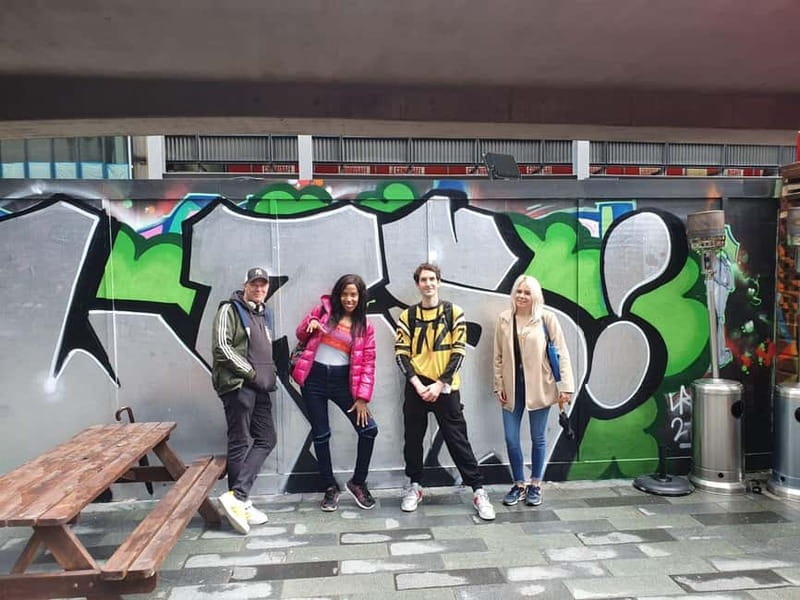
The small group limit helps. With no more than 15 people, you should have a better chance to hear the explanations in busy streets and ask something specific. One booking ran with only three people, and the guide still operated the tour rather than canceling. That suggests useful flexibility for small bookings, though group size can vary.
A good choice for families and first-time visitors
The tour works well for adults who want a serious look at art, but it is not limited to art students or dedicated graffiti fans. Families can use the walk as a way to explore East London while giving children something concrete to look for.
The subject can hold the attention of teenagers and younger children because the streets provide immediate visual examples. The stories about rivalries, secretive practices, public space, and artists working outside traditional galleries can also prompt good conversations between parents and children.
A 12-year-old and a 14-year-old were both able to engage with the tour, and one family with children aged 7, 10, and teenagers found that the whole group stayed involved. That does not mean every child will enjoy 2.5 hours of walking and discussion, but the format has wider appeal than a conventional art tour.
For adults, the value is that the tour changes how you see the rest of London. Afterward, you are more likely to notice lettering, pasted images, tags, and pieces tucked above eye level. You can use the same questions in other cities, too: Who made this, who is it for, what is it responding to, and how long might it last?
Timing, price, and practical comfort
At $22 per person, the tour offers good value if you want explanation rather than a self-guided photo walk. You are paying for 2.5 hours with an English-speaking guide, a route through Shoreditch and Brick Lane, access to at least three Banksy works, and a detailed discussion of many other artists.
A cheaper option is to walk the area alone. That can work if you mainly want photographs, but you may miss the codes, rivalries, political context, and artistic differences that make the walls worth studying. The tour earns its price through interpretation.
Wear comfortable shoes and dress for the weather. You are outside for the full walk, and winter conditions can make the experience cold. Photography is allowed and encouraged, but if artists are working, you must keep your distance and not photograph them without clear permission.
The tour is offered in English and is not suitable for wheelchair users. Since the experience takes place on East London streets and includes side areas and changing public surfaces, anyone with mobility concerns should check carefully before booking.
You can cancel up to 24 hours before the start for a full refund, and the reserve-now, pay-later option keeps your plans flexible. Those policies are useful if your London schedule is still shifting.
Who should book this tour?
I would choose this walk if you want to understand why a piece matters, not just photograph it. It is especially good for first-time street art visitors, curious families, photographers, art students, and anyone who has walked through Shoreditch before without knowing what to look for.
It is also a smart choice if Banksy interests you but you do not want a tour that treats him as the entire story. You get the famous works, then move into London’s wider graffiti culture, including Ben Eine, local writers, political themes, and the Team Robbo conflict.
I would think twice if you dislike walking outdoors, need step-free access, or want a fixed list of guaranteed artworks. Public street art changes, and the fourth Banksy piece depends on access. You should also expect discussion and analysis, not just quick stops for photographs.
Final verdict: book it if you want to read East London differently
Book this tour if you want Shoreditch and Brick Lane to make more sense. James brings together Banksy, Ben Eine, London writers, graffiti slang, politics, gentrification, social media, and artistic technique without losing sight of the actual streets around you.
The best result is not the number of Banksy photos on your phone. It is the new habit of looking closely at every wall afterward. At $22, that change in perspective is a fair price, and the small groups make the experience feel personal rather than mass-produced.
FAQ
How long does the Advanced Graffiti Street Art Tour last?
The tour lasts 2.5 hours.
Where does the tour take place?
It explores Shoreditch, Brick Lane, and other parts of East London.
How many Banksy works will I see?
The tour includes at least three Banksy artworks. A fourth may be included, depending on access.
Who leads the tour?
The tour is led in English by James from Jam Graffiti Tours.
Is photography allowed?
Yes. Photography is allowed and encouraged. If artists are working, you should act discreetly and not photograph them without their express permission.
Is the tour suitable for wheelchair users?
No. The tour is listed as not suitable for wheelchair users.
Can I cancel or pay later?
Yes. You can cancel up to 24 hours in advance for a full refund, and you can reserve your place and pay later.
New street art tours in London
- The Great Street Art Experience★ 5.0 · 2 reviews
- London Street Art Tour of the East End Semi-Private 12ppl Max★ 5.0 · 23 reviews
- London Street Art Tour of the East End Exclusive Walking Tour★ 5.0 · 12 reviews
- Shoreditch Street Art Private Photography Tour including Brick Lane★ 5.0 · 5 reviews
- London Unexpected Private Tour – Markets, Street Art & Camden Town★ 5.0 · 2 reviews
- Private Royal London Bike Tour with pub & street art★ 5.0 · 2 reviews
- 3-Hour Private Tour of East London Graffiti & Street Art★ 4.5 · 5 reviews
- East End London Instagrammable Street Art and Graffiti Tour★ 5.0 · 16 reviews
Graffiti Tours, side by side.

Comuna 13 Graffiti Tour, Cable Car & Street Food
Read our review →


Brooklyn Graffiti & Street Art Walking Tour in Bushwick
Read our review →
Comuna 13 Tour with Snacks And Your Own Graffiti
Read our review →Lists this wall walk turns up in