
Reviewed · MURALISM TOURS
Exploring Mexican Muralism: A Journey through Bellas Artes Palace
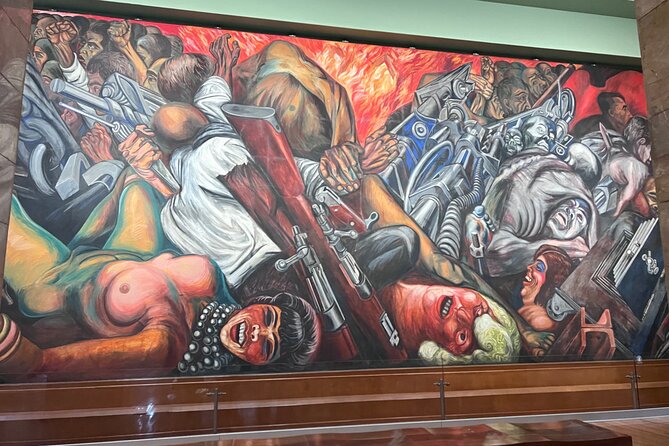
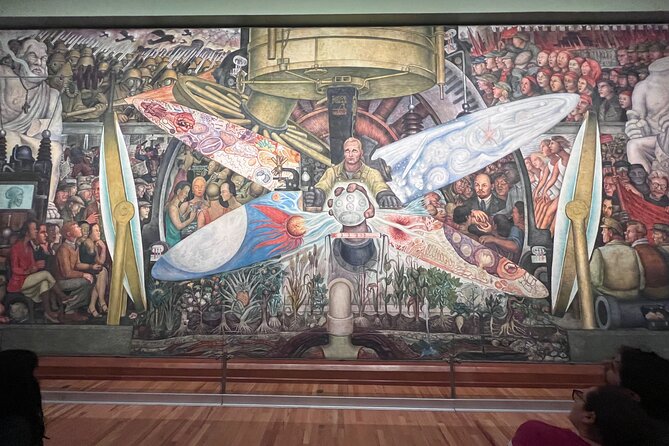
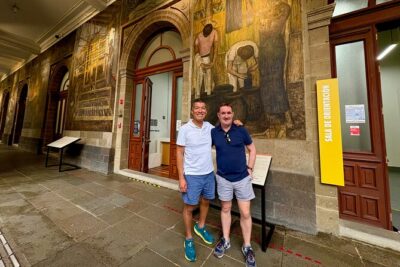
The most compelling part of this experience is the way it treats the murals as more than handsome wall decorations. Inside Mexico City’s Palacio de Bellas Artes, Diego Rivera, José Clemente Orozco, David Alfaro Siqueiros, and Rufino Tamayo present competing views of Mexico’s past and future. The paintings become a visual guide to revolution, labor, mythology, and social change.
I like the small maximum of six people, which should make it easier to ask questions and follow a discussion. I also like the clear split between the palace architecture and the 80-minute mural visit. Guide Mercedes Iriondo is praised for her patience, enthusiasm, and ability to connect art with politics and economic change. The main drawback is the short overall length: at about 90 minutes, this is a focused introduction, not a full study of every work in the palace.
Key points to know before booking
- See four major muralists in one setting: Rivera, Orozco, Siqueiros, and Tamayo offer distinct views of Mexican identity and history.
- Start with the building itself: The first 10 minutes focus on the facade, architectural details, and unusual features of Bellas Artes.
- Expect a discussion-led tour: Mercedes welcomes questions and explains how each artist’s style and subject matter differ.
- Small groups matter: The tour is limited to six people, a useful format for looking closely and speaking up.
- Meet at 11 a.m. by the Madero Monument: The tour begins in Centro and returns to the same meeting point.
- Price the time, not just the ticket: At $60 per person for about 90 minutes, the value depends on how much context you want with the art.
Why Bellas Artes works so well for a mural tour
Mexico City has no shortage of museums, churches, plazas, and public art. Bellas Artes is especially useful for a short guided visit because several major muralists are gathered under one roof. You do not need to cross the city to compare their ideas, methods, and subjects.
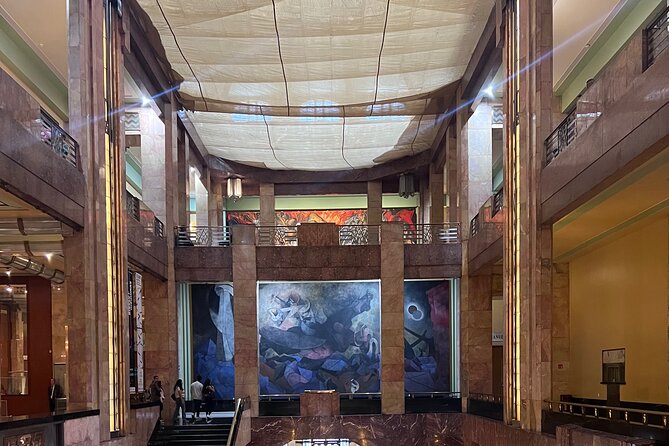
The building gives the visit a strong beginning. Before you study the paintings, you spend about 10 minutes looking at the palace facade and its distinctive architectural elements. That matters because Bellas Artes is not simply a neutral container for art. Its exterior and grand interior create a formal setting for paintings that often question power, inequality, religion, work, and national identity.
I like this opening because it slows you down. Many people rush toward the murals and miss the building. Here, you begin by looking at the place itself, including details that can be easy to overlook without guidance.
The architectural portion is brief, so you should not book this expecting a full architectural tour of Mexico City. It functions more as an introduction. You get enough context to understand why the palace feels important, then move toward the central subject: Mexican muralism.
More muralism tours in Mexico:
- CDMX: Xochimilco, Coyoacan, Frida Kahlo Museum & Murals Tour
★ 4.4 · 3,025 reviews - La Catrina & Muralism: Diego Rivera’s Legacy & Frida Kahlo
★ 4.5 · 197 reviews - Muralist Art Semi Private Walking Tour in Mexico City Downtown
★ 5.0 · 188 reviews
The first 10 minutes: reading the palace facade
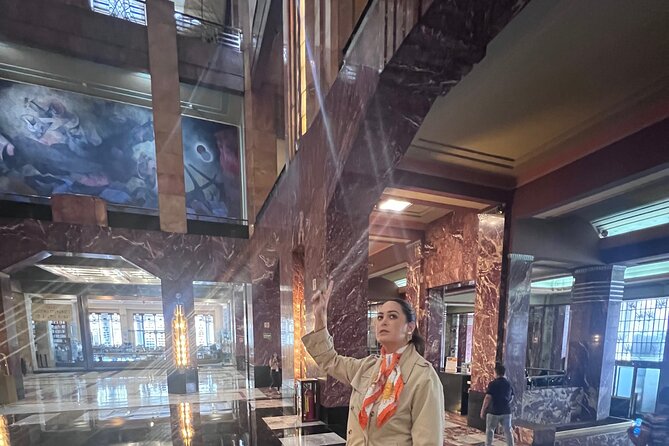
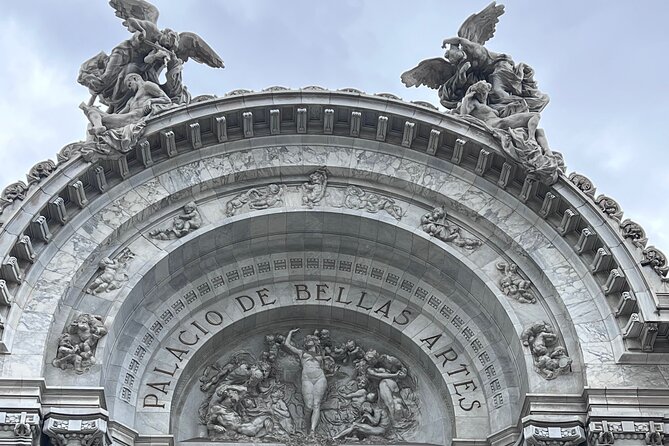
The tour starts at the Madero Monument in Centro at 11 a.m. From there, the opening portion focuses on Palacio de Bellas Artes. You will examine the facade and the elements that make it distinctive, along with less obvious features that add to its appeal.
The supplied details do not identify each architectural feature by name, so you should expect interpretation rather than a technical catalog. That is a fair use of the limited time. The point is to help you look carefully before entering, not to cover every chapter of the building’s design.
This first stop also gives you a practical transition from the streets of central Mexico City into a more concentrated art experience. The meeting point and return point are the same, which keeps the tour simple. Bellas Artes is near public transportation, another help if you are fitting the visit between other plans in Centro.
Inside Bellas Artes: four artists, four points of view
The interior visit lasts about 80 minutes. This is where the tour earns its price, especially if you want to understand the murals instead of simply photographing them.
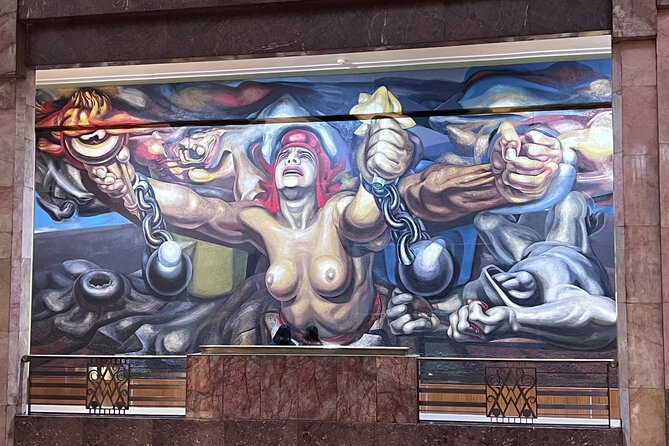
The works present scenes and ideas connected with the Mexican Revolution, labor struggles, mythology, social change, rural life, urban life, industrialization, and the country’s pre-Hispanic past. The paintings also connect older traditions with a contemporary Mexico still changing around the artists.
That range gives Mercedes plenty to explain. She places the murals in a sequence of political, cultural, and economic shifts, helping you see why subject matter and style matter together. A factory scene is not just a factory scene. A heroic figure, a worker, or a mythological image can carry an argument about national identity and social power.
Diego Rivera
Rivera’s work is part of the central conversation. His murals are often filled with large figures, strong visual structure, and scenes that link ordinary people with national events. Here, his work can be read in relation to labor, revolution, and the effort to tell Mexican history through public art.
A guide adds value by pointing out how the composition directs your attention. You can look at a mural and notice its scale, colors, and crowded scenes. With context, you begin to ask who is represented, who is missing, and what version of the nation the artist wants you to see.
More street art tours worth booking in Mexico:
- Cancun Street Food Tour with Food Stalls, Local Market and Murals
★ 5.0 · 723 reviews - Mexico City; ART NACO : Murals & Street Art Bike Tour
★ 5.0 · 284 reviews - History and Murals: Walking Tour Guadalajara
★ 5.0 · 237 reviews - Walking Tour – Impressive murals in Historical Center of Mexico City
★ 5.0 · 224 reviews
José Clemente Orozco
Orozco brings another tone to the group. His work is connected with the upheaval and human cost of political change. The differences between his approach and Rivera’s are part of the reason this tour works better than a quick solo pass through the hall.
You will not just hear a list of names. The tour is designed to compare the artists’ styles and the ideas behind their images. That comparison helps you remember the works after you leave, since each mural starts to have its own voice.
David Alfaro Siqueiros
Siqueiros adds another forceful view of social and political life. His work can be considered alongside themes of workers, industrialization, and the public role of art. The murals are not quiet private pictures. They were made to confront large questions in a public building.
I particularly like the emphasis on the artists’ commitment to the country and its people. That does not mean you have to accept every political message. It means you get a better basis for judging the work on its own terms.
Rufino Tamayo
Tamayo broadens the comparison. His work brings mythology, cultural identity, and changing ideas of modern Mexico into the discussion. Seeing his work alongside Rivera, Orozco, and Siqueiros helps you notice that Mexican muralism was not one fixed style with one single message.
This is where the guide’s role becomes important. If you visit alone, you may admire the color and scale but miss the relationship between the artists. Mercedes is described as patient and generous with her time, and that suits a museum visit where questions can lead to useful side paths.
What makes Mercedes’s guiding style useful
The strongest praise of this experience centers on Mercedes Iriondo. She is identified as a master of arts guide, and the available feedback repeatedly points to her command of Mexican history, culture, politics, and economic transitions.
That combination is useful because muralism sits between art and public life. You need some visual vocabulary, but you also need a sense of the events and arguments behind the images. Mercedes connects those parts rather than treating the paintings as isolated masterpieces.
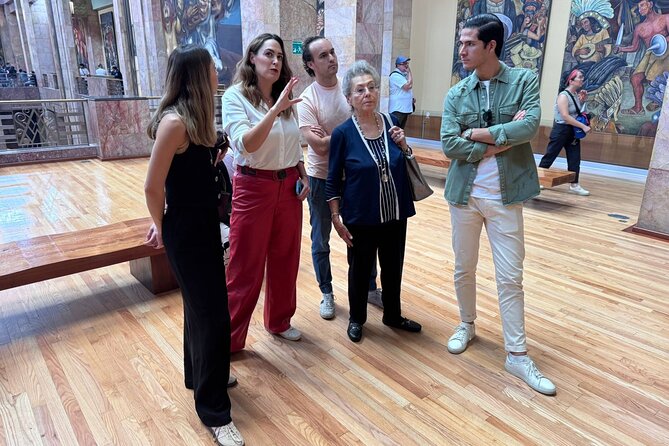
You can ask questions during the visit, and the small group makes that more practical. With no more than six people, the experience should feel less like a lecture delivered to a crowd and more like a guided conversation. That format is especially helpful if you want to compare details or ask why two artists present similar subjects in different ways.
The feedback also points to her patience. That matters in Bellas Artes, where the murals can be visually dense. You may need a moment to locate a figure, follow a scene, or understand how one section relates to another. A guide who allows questions and takes time with details can make the difference between looking and seeing.
The tour does not promise an academic seminar, and 80 minutes is not enough for one. But it does offer a thoughtful framework. You leave with a clearer sense of how art, politics, culture, and national development meet inside these walls.
Is $60 a fair price for 90 minutes?
The cost is $60 per person, with admission to the interior portion included. At first glance, that is a meaningful amount for a one-and-a-half-hour activity. The value depends on how you prefer to visit museums.
If you are happy to walk through Bellas Artes alone and read whatever information is available on site, you may find the price high. The tour is not the cheapest way to enter a museum. It is priced as a small private-style experience, with an English-speaking guide and a maximum of six people.
If you want the paintings explained in relation to Mexican history and social change, the calculation looks better. You are paying for selection, interpretation, and the chance to ask questions. The small group also gives you a better chance of staying engaged than a large sightseeing group.
The experience has received a top rating from nine completed ratings, and the praise focuses on the guide’s preparation, patience, and ability to connect the murals with broader history. That is useful evidence about the tour’s main strength, though it does not change the time limit.
I would see this as a good-value choice for someone who has limited time in Mexico City and wants a serious introduction to Mexican muralism. I would look elsewhere if you want a long, highly technical art-history session or a full tour of every part of the palace.
Timing, meeting point, and group size
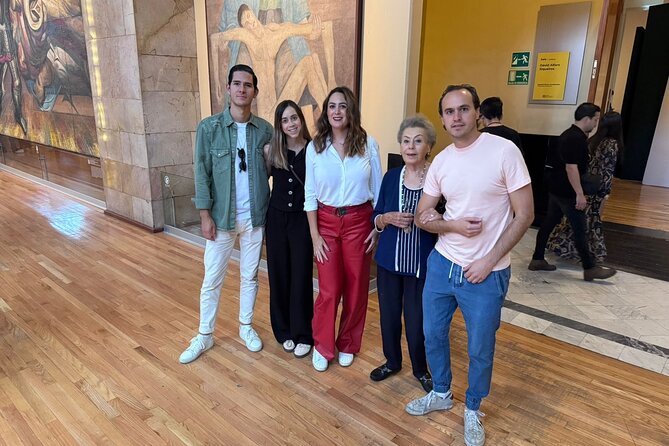
The meeting point is the Madero Monument in Colonia Centro, at 11 a.m. The activity ends back at that meeting point. You should build a little spare time into your morning so you are not trying to find the monument at the last moment.
The tour is offered in English. It is near public transportation, which makes it practical for a day based in central Mexico City. The supplied information does not give a recommended route, so use the meeting point exactly as provided when planning your arrival.
The maximum group size is six. That is one of the clearest advantages of the experience. In a museum setting, a small group can gather around a mural without the guide needing to shout across a large crowd. It also supports the question-and-answer style that Mercedes is praised for.
Most people can participate. No special physical requirements are listed, but you will be inside a major public building for most of the tour and on your feet for an extended period. The exact seating arrangements and route details are not specified, so anyone with particular mobility needs should confirm those points before booking.
Confirmation is provided at booking. You can cancel for a full refund up to 24 hours before the start time. Changes or cancellations inside that window are not accepted for a refund, and the cut-off follows Mexico City local time.
Who will get the most from this experience?
I would recommend this tour to you if you enjoy art more after someone explains its setting. It is a particularly good match for first-time visitors who want a clear introduction to Mexican muralism without spending half a day in a classroom.
It also suits people who like history told through objects and images. The murals cover the Revolution, labor, mythology, rural and urban life, industrialization, and social evolution. That gives you a useful way to think about Mexico beyond dates and monuments.
Couples and small parties should benefit from the six-person limit. Solo visitors may also appreciate the chance to ask questions without having to arrange a private guide.
The tour may be less suitable if you want a casual photo stop. The visit asks you to pay attention to composition, historical context, and artistic differences. You can still enjoy the building’s beauty, but the focus is on understanding what you are seeing.
I would also keep expectations realistic. This is a 90-minute tour, not a complete exploration of Bellas Artes or the entire history of Mexican art. Its strength is focus. You get a close look at the palace facade, then a sustained discussion of major murals.
Should you book the Bellas Artes mural tour?
Book it if you want the murals to make sense, not just look impressive. The combination of a small group, English guidance, and Mercedes Iriondo’s history-centered approach gives you a thoughtful introduction to one of Mexico City’s most important art settings.
The best reason to choose it is the connection between artists and ideas. Rivera, Orozco, Siqueiros, and Tamayo are not presented as four famous names in a hallway. You are encouraged to compare their styles and consider how each artist addressed Mexican identity, conflict, work, mythology, and change.
Skip it if $60 feels too high for 90 minutes or if you prefer completely independent museum visits. But if your Mexico City schedule is tight and you want one well-organized art experience in Centro, this is a sensible pick. The small group and strong guide focus make it more useful than a quick walk through the palace on your own.
FAQ
How long does the Bellas Artes mural tour last?
The experience lasts approximately 1 hour and 30 minutes. About 10 minutes focus on the palace exterior and architecture, followed by about 1 hour and 20 minutes inside with the murals.
What time does the tour start?
The tour starts at 11 a.m.
Where does the tour meet?
You meet at the Madero Monument in Colonia Centro, Cuauhtémoc, Mexico City. The activity ends back at the same meeting point.
Is the tour offered in English?
Yes. The tour is offered in English.
Which artists’ murals will I see?
The tour discusses murals by Diego Rivera, José Clemente Orozco, David Alfaro Siqueiros, and Rufino Tamayo.
How many people can join the tour?
The activity has a maximum of six participants.
Does the price include admission?
Admission to the interior portion at Palacio de Bellas Artes is included. The listed price is $60 per person.
Can I cancel for a full refund?
Yes. You can cancel at least 24 hours before the start time for a full refund. Cancellations or changes made less than 24 hours before the start time are not accepted for a refund.
New street art tours in Mexico
- Xochimilco floating gardens, Coyoacan and UNAM murals★ 4.0 · 6 reviews
- UNAM: Murals & Revolution★ 4.9 · 8 reviews
- Graffitis & Munchies biketour Playa del Carmen★ 4.5 · 18 reviews
- Street Art & Cemetery Cultural Tour – half day★ 5.0 · 3 reviews
- Street Art Walk★ 4.5 · 7 reviews
- Tour Women Muralists : Strokes that resist Mexico City★ 5.0 · 7 reviews
- Mexico City Private Tour with Teotihuacan, Murals, Guadalupe Basilica★ 3.0 · 2 reviews
- Diego Rivera’s murals, hidden treasures★ 5.0 · 21 reviews
Muralism Tours, side by side.
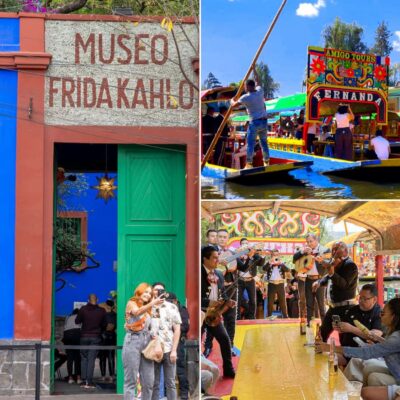
Xochimilco, Coyoacan, Frida Kahlo Museum & Murals Tour
Read our review →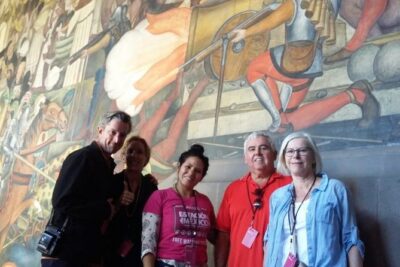
La Catrina & Muralism: Diego Rivera’s Legacy & Frida Kahlo
Read our review →
Muralist Art Semi Private Walking Tour in Mexico City Downtown
Read our review →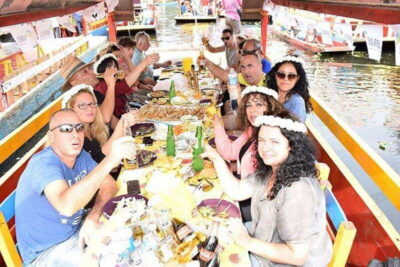
Xochimilco floating gardens, Coyoacan and UNAM murals
Read our review →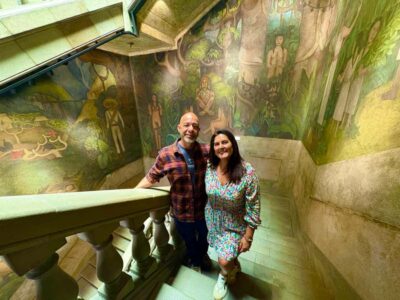
La Catrina & Muralism: Diego Rivera’s Legacy & Frida Kahlo
Read our review →Lists this wall walk turns up in