
Reviewed · POLITICAL AND PROTEST MURAL TOURS
UNAM: Murals & Revolution
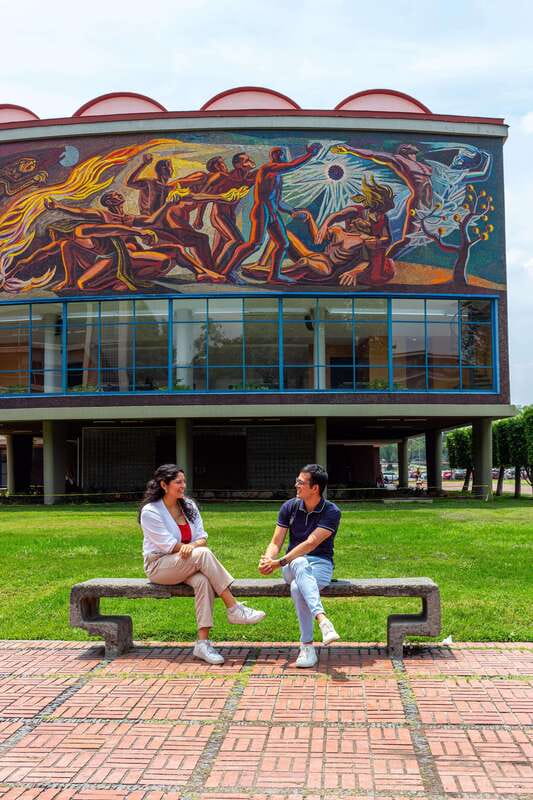
UNAM turns a university walk into a lesson in Mexican identity. You’ll read murals by O’Gorman, Siqueiros, Chávez Morado, and Eppens, then connect their images to education, student revolts, and public life. I like the clear two-hour shape, and I like that the tour ends with Diego Rivera rather than stopping at the library.
The best guides make this work. José and Jesús have been singled out for their personable, engaging approach, while the tour is also available in Spanish, English, German, Italian, and Portuguese. The main consideration is pace: two hours covers a lot, so this suits you if you want interpretation and context more than a long, leisurely campus wander.
Key points at a glance
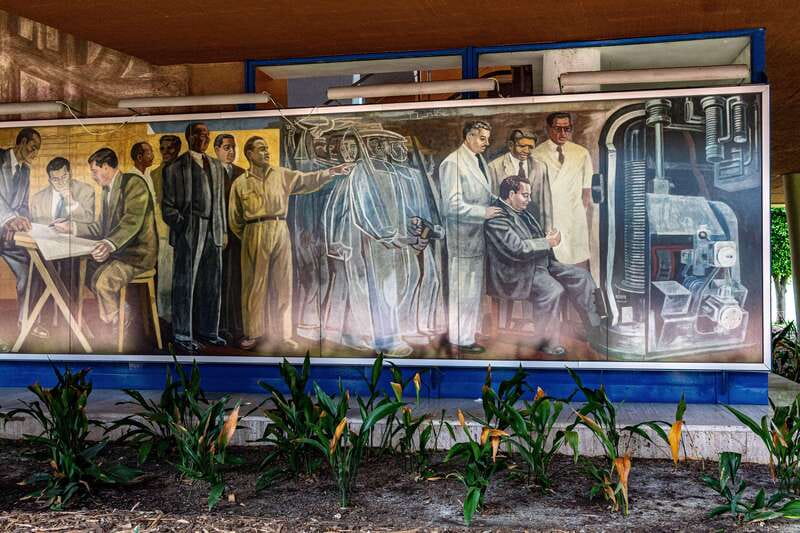
- Four major muralists in one university setting: Read works by Siqueiros, O’Gorman, Chávez Morado, and Eppens.
- A UNESCO-listed campus: Begin at Rectoría, near the commemorative plaque marking UNAM’s heritage status.
- History beyond the paint: Connect the murals with Mexican education, student revolts, and the university’s role today.
- A final Diego Rivera stop: See La universidad, la familia y el deporte en México from outside Estadio Olímpico Universitario.
- A compact, guided route: The experience lasts two hours and returns you to Rectoría.
- Five language options: Tours are offered in Spanish, English, German, Italian, and Portuguese.
Why UNAM’s murals matter
Mexico City has no shortage of murals, but UNAM gives you a useful setting for understanding why public art mattered so much in Mexico. These works are not tucked into a private gallery. They are placed on the buildings and spaces of a major university, where ideas about learning, work, family, politics, and national identity meet.
That setting changes how you look at the art. You are not simply checking off famous painters. You are hearing how the university grew from Mexico’s wider effort to build a public education system, and how students later challenged authority through protest.
I like this approach because it gives the murals a job beyond decoration. The guide helps you ask what each image is saying, who it was meant for, and why it belongs on a university campus. You get art history, but you also get a look at the public role of education in Mexico.
The subject can be serious, yet the tour is not designed as a lecture with your eyes fixed on a wall. The guide is expected to explain, answer questions, and connect the images to modern Mexico. That interactive element matters, especially if you do not already know the artists.
More muralism tours in Mexico:
- CDMX: Xochimilco, Coyoacan, Frida Kahlo Museum & Murals Tour
★ 4.4 · 3,025 reviews - La Catrina & Muralism: Diego Rivera’s Legacy & Frida Kahlo
★ 4.5 · 197 reviews - Muralist Art Semi Private Walking Tour in Mexico City Downtown
★ 5.0 · 188 reviews
Starting at Rectoría and the UNESCO plaque
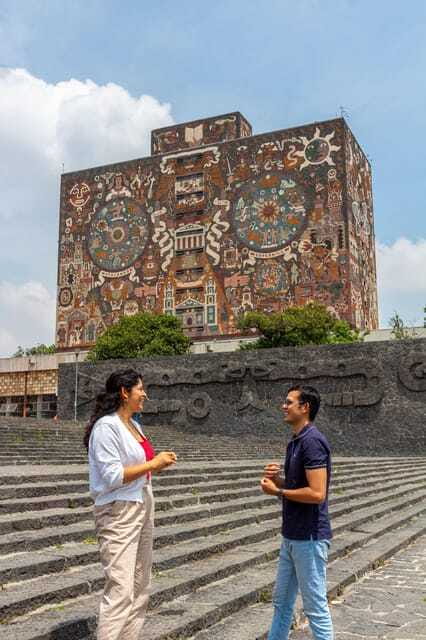
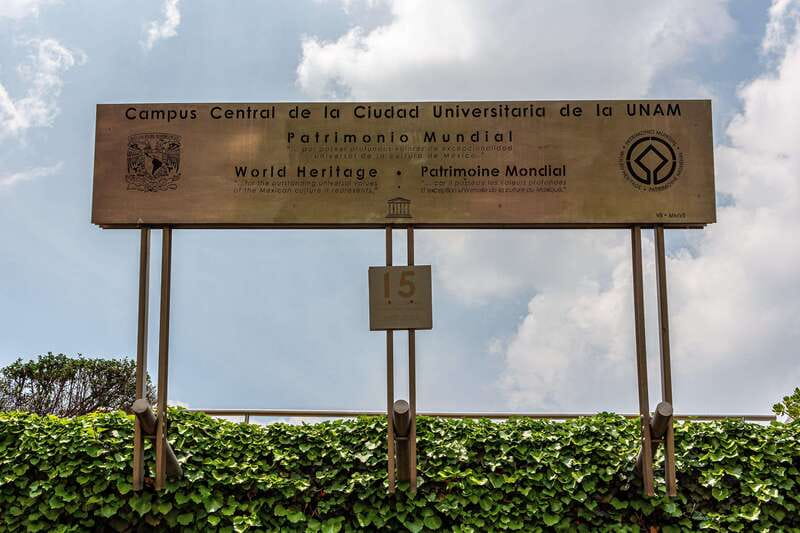
The tour begins at the Rectoría building, in front of the UNESCO commemorative plaque. This is a practical meeting point because it gives you a clear landmark and places you at the heart of the campus from the start.
Look for the guide carrying a small Mexican flag. That detail is useful in a busy meeting area, particularly if you arrive early and several groups are gathering nearby. The provider is José Vicente Figueroa, and individual guide assignments can vary. Past praise has specifically highlighted guides named José and Jesús for being personable, engaging, and clear when answering questions.
The opening stop also sets the tone. UNAM is not being presented only as a collection of buildings with attractive artwork. The university’s heritage status becomes part of the story, and you begin to see the campus as a place where architecture, civic life, and art work together.
You should arrive ready to walk and look upward. Much of the value comes from seeing the artwork in its original setting, not from rushing past it as a photo stop. Since the tour lasts only two hours, keep the opening questions focused enough to leave time for the murals and stadium.
Reading the Central Library murals
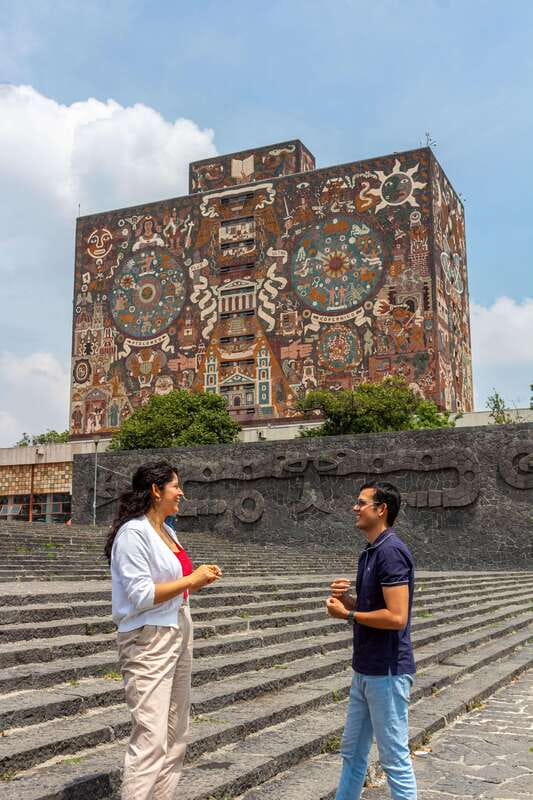
The Central Library receives about 30 minutes of guided attention. That may sound brief, but a focused explanation can be more useful than wandering around a large building without knowing what to look for.
The library is tied to Juan O’Gorman, one of the artists included in the tour. Here, the guide can help you read the images as a large-scale story rather than as a collection of colorful shapes. The larger point is how public art can present ideas about Mexico to students and the wider community.
Take your time with the symbols and scenes. You might find that the mural works best from a little distance, when its overall design comes together, while smaller details reward a closer look. The guide’s role is important because a mural of this size can be hard to read without some direction.
This is also a good place to consider the difference between seeing a mural independently and seeing it with an interpreter. On your own, you can admire the scale and color. With the guide, you can connect the artwork to national history, education, and the political hopes attached to public buildings.
A possible drawback is that 30 minutes will not satisfy anyone who wants a detailed study of every section. You may need to accept a broad reading rather than a full art-history seminar. The tradeoff is a brisk tour that reaches several important works in one morning or afternoon.
Siqueiros, Chávez Morado, and Eppens across campus
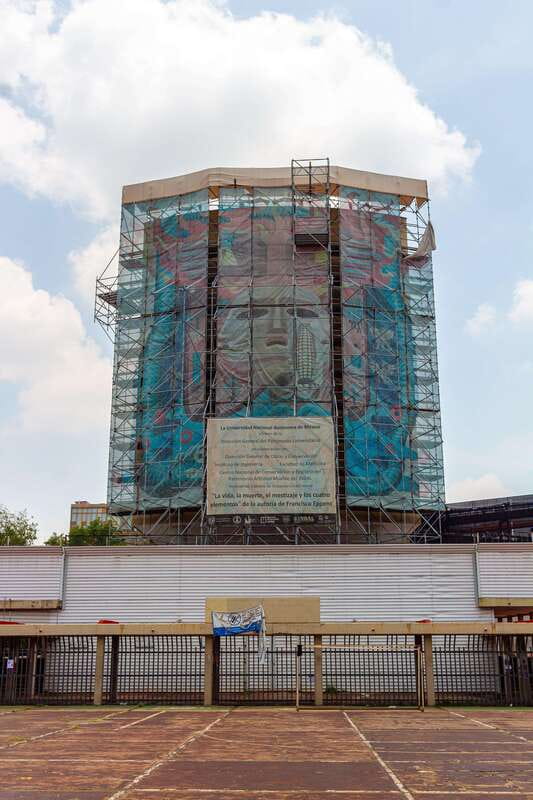
After the library, the route continues through campus to examine works by David Alfaro Siqueiros, José Chávez Morado, and Francisco Eppens. The supplied schedule gives this part about an hour, making it the longest portion of the experience.
That extra time matters. Instead of treating UNAM as one famous mural and a quick photograph, the tour introduces several artistic voices. You can compare how each painter uses figures, movement, symbols, and public space.
Siqueiros is known for forceful, politically charged imagery, and his work gives the discussion a strong connection to social change. Chávez Morado and Eppens add further range, helping you see that Mexican muralism was not one fixed style made by one small circle of artists.
I appreciate the chance to compare the artists in one walk. You do not have to remember every date or title to benefit. Focus on the questions the guide raises: What view of society does this work present? Who is represented? Is the university shown as a place of order, struggle, progress, or all three?
The discussion also moves beyond painting technique. You will hear about the beginnings of education in Mexico, the student revolts, and the value of UNAM in the country today. Those subjects give the murals a present-day connection. The campus is not treated as a museum frozen in the past.
Because the tour is guided in several languages, the quality of the explanation will depend partly on the language you choose and the guide assigned that day. Spanish and English are listed, along with German, Italian, and Portuguese. Some content may be presented in its original language, so ask for clarification if a term or explanation moves too quickly.
More political and protest murals in Mexico:
- Guided Walking Tour Describing UNAM Murals and Revolution
★ 5.0 · 8 reviews - Belfast’s Political Mural Taxi Tour
★ 5.0 · 1,180 reviews - Belfast: Private Black Taxi Cab Political Murals Tour
★ 4.9 · 425 reviews - Political Wall Murals and Peacewall
★ 4.9 · 247 reviews
The student revolts and the university today
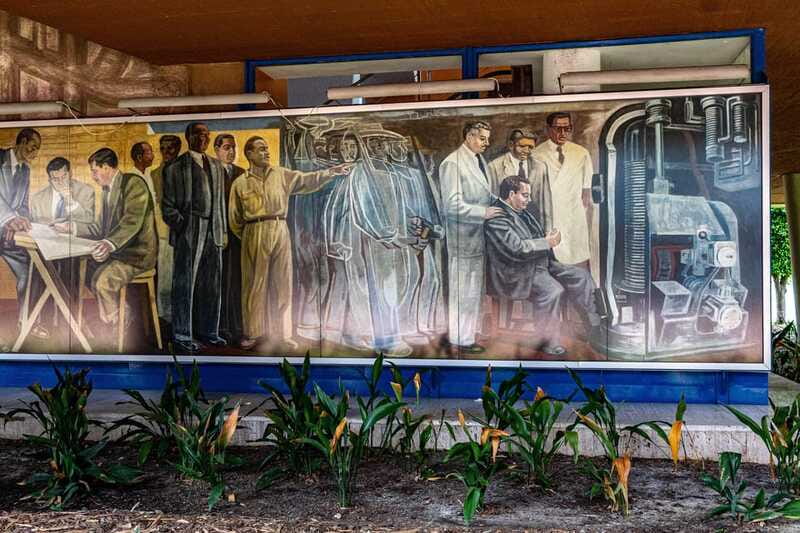
The section on student revolts is one of the reasons to choose this experience instead of a basic campus sightseeing walk. Student movements are part of the university’s public identity, and the topic helps explain why UNAM can mean more than classrooms and research.
You will also discuss the university’s value in present-day Mexico. This widens the tour from art appreciation to civic context. The murals become evidence of how a public institution wants to see itself and how students and citizens have contested that image over time.
I would not book this tour expecting a complete account of every political event connected with UNAM. Two hours cannot do that. Instead, think of the discussion as a framework. It gives you enough background to understand why the artworks carry political and educational weight, then leaves you with subjects you can explore later.
This is where a good guide makes the largest difference. Reviews of José and Jesús emphasize clear answers and an engaging manner. That is exactly what you want for a topic that could become dry or overly academic. A guide who invites questions can help you link the paintings to the concerns you see elsewhere in Mexico City.
Ending at Estadio Olímpico Universitario
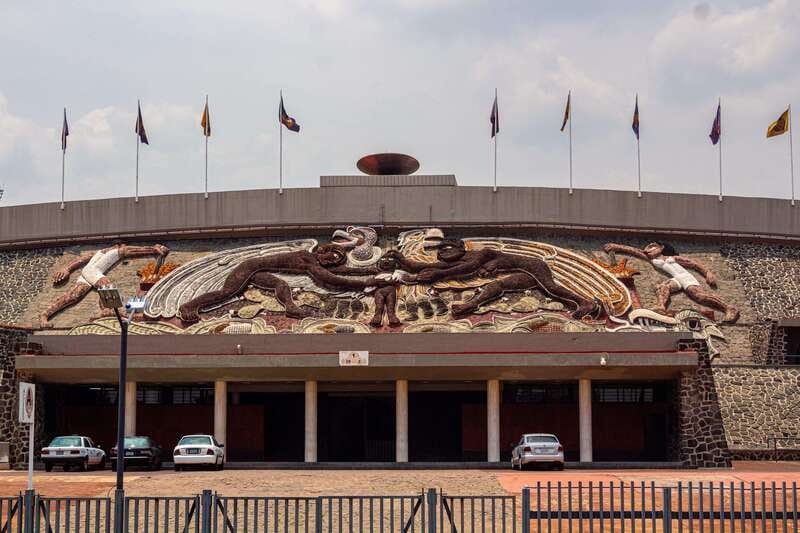
The final stop is Estadio Olímpico Universitario, where you see Diego Rivera’s La universidad, la familia y el deporte en México. The tour visits the stadium from outside, so you should not expect an interior stadium experience or a sporting event.
The ending works well because it adds a different setting and a different artist. After spending most of the tour with campus buildings and several muralists, you reach a large public sports venue and consider how the university presents family, athletics, and education together.
Rivera’s title alone points to the subject: the relationship among the university, family, and sport in Mexico. The guide can help you place the mural within the wider ideas raised earlier in the tour. Education is no longer shown only through books or classrooms. It becomes part of a larger social life.
Allow yourself a few minutes to look carefully rather than treating this as a final photo stop. Since the stadium is viewed from outside, expectations matter. If you want a full stadium tour, this is not that. If you want one more major piece of public art and a strong closing idea, it rounds out the route nicely.
The group then returns to Rectoría. That makes the tour easy to fit into a day of sightseeing because you finish where you began, rather than being left at an unfamiliar part of the city.
Is $52 a fair price?
At $52 per person, this is not the cheapest way to walk around UNAM. You are paying for the guide’s interpretation, the organized route, and the connections among art, education, politics, and university life.
The value is strongest if you would otherwise look at the murals without understanding them. Four artists, a UNESCO connection, the Central Library, and Rivera’s stadium mural would take planning to combine on your own. The guide also saves you from having to research each work before arriving.
The value is weaker if you mainly want photographs or prefer to explore at your own pace. The schedule is fixed, the walk is compact, and the tour is built around explanation. You may want more time at one mural than the group can spare.
The 4.9 rating from eight reviews is encouraging, especially because the praise is specific. José is described as personable, and Jesús as engaging. Another review in Spanish highlights an educated guide who answers questions clearly and allows interaction. That pattern suggests the guide is the main reason to pay for the experience, not simply access to a place you could walk through independently.
Free cancellation up to 24 hours before the start and the option to reserve without paying immediately add useful flexibility. You still need to check the available starting times, since the tour is only two hours and the schedule can affect how you arrange the rest of your Mexico City day.
Who will get the most from this tour?
I would recommend it most strongly to you if you enjoy art with a social and political setting. You do not need a background in Mexican art. In fact, the tour may be most useful if you know the names of Rivera and Siqueiros but want a clearer sense of how their work fits into Mexico’s public life.
It also suits first-time visitors who want a structured introduction to UNAM. The route covers the main themes without taking an entire day, and the return to Rectoría keeps the plan simple.
Families with older children or teenagers may find the education and student-revolt topics more engaging than a standard monument visit. The murals offer plenty to look at, while the discussion gives young people a way to connect art with questions about school, protest, and society.
You might skip it if you want a quiet, unstructured walk, a stadium interior visit, or a long technical discussion of painting methods. You should also be comfortable keeping pace with a two-hour route and sharing the guide’s attention with the group.
Practical details before you book
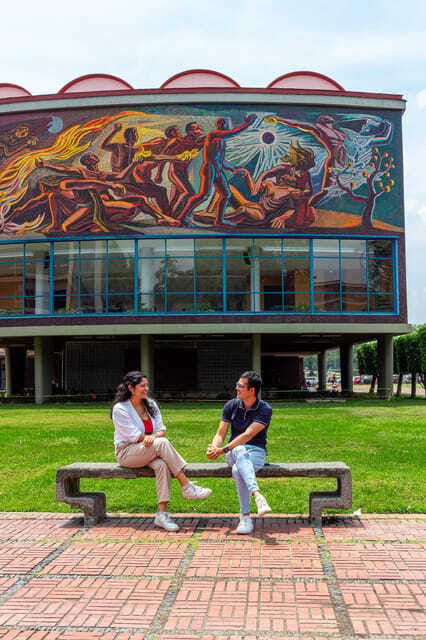
The meeting point is Rectoría, directly in front of the UNESCO plaque. Find the guide with a small Mexican flag. That is the key identification tip provided for the meeting.
The duration is two hours. The Central Library receives about 30 minutes, the middle campus section about one hour, and the Estadio Olímpico Universitario stop about 30 minutes. The route begins and ends at Rectoría.
Guiding is available in Spanish, English, German, Italian, and Portuguese. Some material may be shown in its original language, so use the language selection that lets you follow historical and artistic details comfortably.
The price is $52 per person. Cancellation is free up to 24 hours before the start for a full refund, and you can reserve now while paying later. Check the available start times before booking so the tour fits your plans.
Should you book UNAM: Murals & Revolution?
Book it if you want to understand what you are looking at, not just walk past it. The combination of O’Gorman, Siqueiros, Chávez Morado, Eppens, and Rivera gives you a strong sample of UNAM’s public art, while the discussion of education and student revolts adds meaning that photographs cannot provide.
The best reason to choose it is the guide-led interpretation. José and Jesús have been praised for clear, engaging explanations, and that human element is central to the experience. Skip it only if you want total freedom, a slower pace, or access inside the stadium. For a focused two-hour introduction to UNAM’s murals and civic role, $52 is a reasonable spend.
FAQ
Where does the UNAM murals tour begin?
It begins at the Rectoría de la UNAM, in front of the UNESCO commemorative plaque.
How will I recognize the guide?
The guide will carry a small Mexican flag.
How long does the experience last?
The tour lasts two hours and returns to Rectoría at the end.
Which languages are available?
The live tour guide is available in Spanish, English, German, Italian, and Portuguese. Some content may be shown in its original language.
Which murals and artists are included?
The route discusses murals by Siqueiros, O’Gorman, Chávez Morado, and Eppens, then finishes with Diego Rivera’s La universidad, la familia y el deporte en México at Estadio Olímpico Universitario.
Can I cancel or pay later?
You can cancel up to 24 hours in advance for a full refund. You can also reserve your place and pay later.
New street art tours in Mexico
- Xochimilco floating gardens, Coyoacan and UNAM murals★ 4.0 · 6 reviews
- Graffitis & Munchies biketour Playa del Carmen★ 4.5 · 18 reviews
- Street Art & Cemetery Cultural Tour – half day★ 5.0 · 3 reviews
- Street Art Walk★ 4.5 · 7 reviews
- Tour Women Muralists : Strokes that resist Mexico City★ 5.0 · 7 reviews
- Mexico City Private Tour with Teotihuacan, Murals, Guadalupe Basilica★ 3.0 · 2 reviews
- Diego Rivera’s murals, hidden treasures★ 5.0 · 21 reviews
- Private Street Food & Mural Art Tour in Mexico City★ 3.5 · 3 reviews
Political and Protest Mural Tours, side by side.
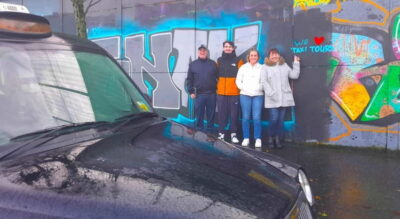
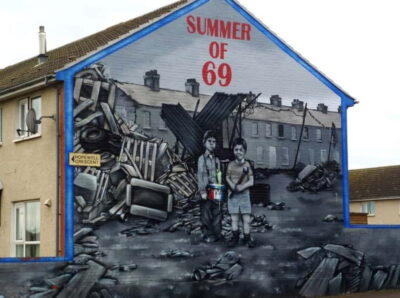

2 Hour Private Belfast Taxi Cab Tour of Troubles & Peace walls
Read our review →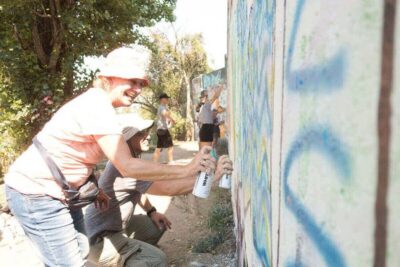

Private Political History & Murals Tour Belfast
Read our review →
Belfast Troubles Murals Street Art and Peace Wall Walking Tour
Read our review →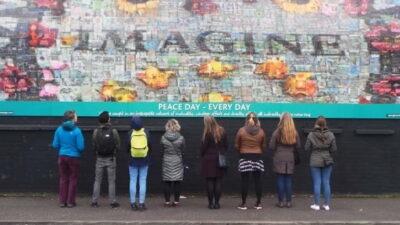
Belfast Troubles : Murals, Street Art, and Peace Wall Tour
Read our review →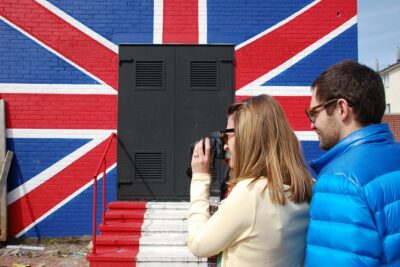
Belfast Famous Black Taxi Tour Political Murals & Peace Wall 2 Hr
Read our review →Lists this wall walk turns up in