
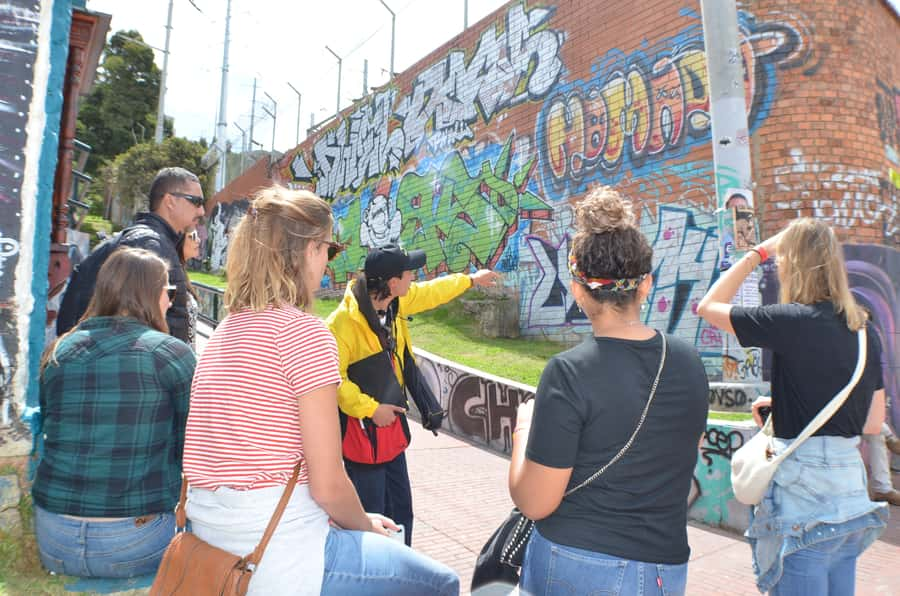
Reviewed · GRAFFITI TOURS
Bogotá: La Candelaria Graffiti & Urban Art Guided Tour
Bogotá tells part of its story in spray paint. This tour leads you through La Candelaria’s lanes to murals about indigenous identity, politics, the environment, and city life, with a guide explaining details you could easily miss on your own. I especially like the small group of up to 10 and the way the walk includes both major murals and less obvious works.
I also like the stop at Café Herencia, where you finish with coca leaf tea in a café that supports local artists. The $16 price is fair for 150 minutes, a local guide, insurance, and the tasting. One thing to consider: the tour may run in English and Spanish at the same time, so explanations may take a little longer or feel less focused in one language.
Key points at a glance
- Murals with a story: Learn how Bogotá’s street art connects to indigenous ancestry, politics, the environment, and daily life.
- Artists worth knowing: See work linked to 3 Manos, Ledania, Bastardilla, Vera, Carlos Trilleras, Wosnan, and Ocio 4.
- A useful La Candelaria walk: Visit Chorro de Quevedo, La Concordia Market, Journalist’s Park, and streets packed with painted walls.
- Small-group format: The maximum group size is 10, leaving room for questions and conversation.
- A local finish: Try coca leaf tea at Café Herencia, a coffee shop that works with and supports artists.
- Plan for the weather: Bring comfortable shoes, water, sunscreen, and weather-appropriate clothing. Umbrellas are provided if rain arrives.
Why Bogotá’s street art deserves a guided walk
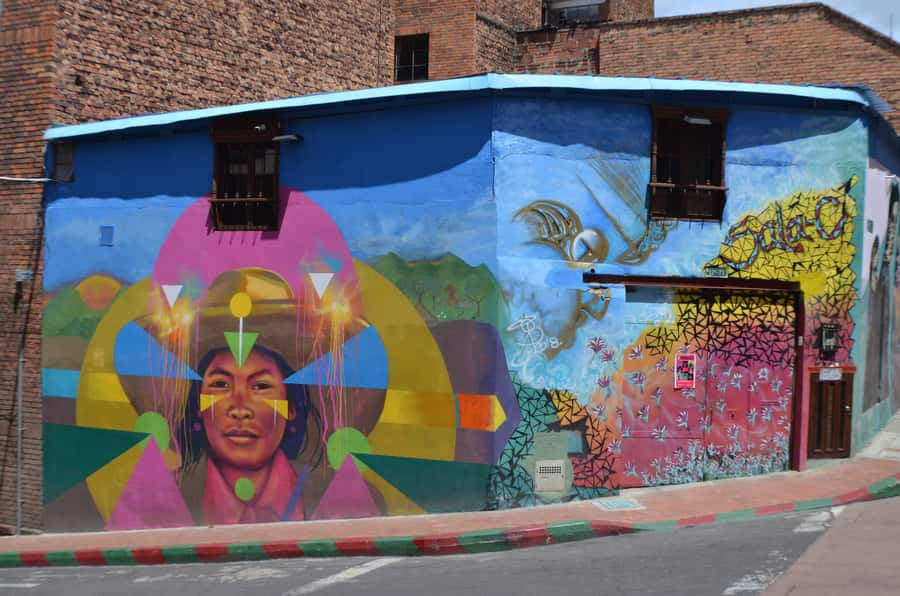
La Candelaria can feel like an open-air gallery, but the paint does not explain itself. A huge mural may look purely decorative until someone points out its symbols, its connection to indigenous ancestry, or the political argument tucked into its figures and colors.
That is where this tour earns its keep. You are not simply walking past painted walls and taking photographs. Your guide gives a short introduction to the social and political setting in which graffiti developed in Bogotá, then connects that background to the works in front of you.
I like this approach because it treats graffiti as public conversation, not just decoration. You hear about tags, murals, different artistic approaches, and the role of women in Bogotá’s urban-art scene. Artists such as Bastardilla, Vera, and Ledania add an important perspective to a route that could otherwise focus too heavily on male artists.
The tour is also a good match for a first or second day in Bogotá. The walk helps you get your bearings in central La Candelaria while giving you a reason to look up, slow down, and notice side streets that you might otherwise pass without a second thought.
More Graffiti Tours in Colombia:
- Medellin: Comuna 13 Graffiti Tour, Cable Car & Street Food
★ 4.8 · 9,046 reviews - Medellín: Comuna 13 Tour with Snacks And Your Own Graffiti
★ 4.9 · 311 reviews - Medellín: Comuna 13 and Graffiti Guided Tour with a Local
★ 4.9 · 239 reviews
Starting at Chorro de Quevedo
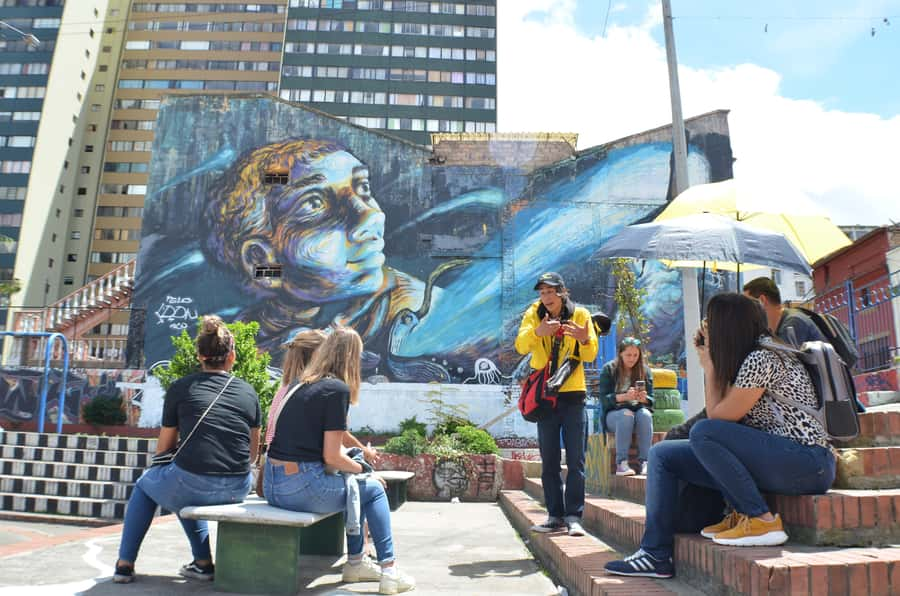
The meeting point is the fountain by the yellow umbrella in Plazoleta del Chorro de Quevedo. Tours run every day at 10 a.m. and 2 p.m., so you can choose a morning walk or an afternoon outing.
Chorro de Quevedo is a useful place to begin because the tour quickly moves from a familiar public square into the older streets of La Candelaria. You should arrive ready to walk rather than expecting a vehicle-based tour. Transportation is not included, and the entire experience takes place on foot.
The route lasts about 150 minutes. That is long enough to cover a good range of murals without turning into an exhausting full-day outing, though you should still wear comfortable shoes. There are several stops where you will pause to study the art and listen, so the pace is not a nonstop march.
The group limit is 10 people. A smaller group matters here because the guide needs to gather everyone around a wall, explain symbols, and answer questions without shouting over a crowd. When numbers are very low, the walk can feel close to a private tour, though that depends on how many people book your departure.
Through La Candelaria, where walls carry arguments
The first major part of the walk lasts about an hour in La Candelaria. You will pass streets lined with graffiti and murals while your guide introduces the local scene and the artists behind it.
Expect a mixture of large, carefully planned murals and smaller tags or painted marks. The guide helps separate those forms, explaining that graffiti and mural work can involve different intentions and techniques. That distinction is useful if you are new to urban art, since a wall full of lettering may communicate something different from a huge figurative painting.
The route includes artists such as Carlos Trilleras, Wosnan, Ocio 4, and 3 Manos. You may also hear about how artists draw on indigenous ancestry and present it in relation to modern Bogotá. Those themes give the work more weight than a quick photo stop would suggest.
The best part of this section is the conversation. Guides including Juana, Luis, Christian, Lorena, Bernardo, and Myra have been praised for explaining both the artwork and its cultural setting. The provider may assign a different guide on your date, but the repeated strength of this experience is the guide’s role in making the walls readable.
Do not expect a museum-style lecture with every fact fixed in advance. The tour is built around what you see in the streets, so the route and discussion may vary with the group and the art selected that day. That flexibility can be a benefit, especially if you want to ask questions.
La Concordia Market and the everyday side of the district
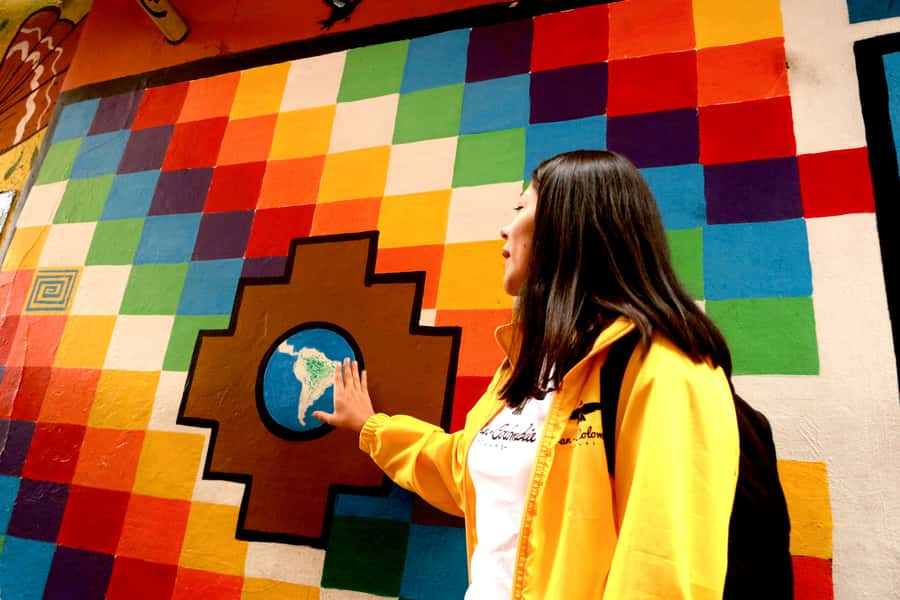
The stop at La Concordia Market lasts about 15 minutes. It is a short visit, but it gives the walk a useful change of pace.
You are not seeing street art in isolation. Markets, squares, cafés, and gathering places help explain how ideas move through central Bogotá. La Concordia has been a meeting point where different influences come together, and the guide connects that setting with the messages shown in nearby art.
The market also provides a glimpse of ordinary neighborhood life between mural stops. I would not book this tour expecting a full food-market visit, since the stop is brief. Instead, think of it as a chance to see one of the district’s social centers and understand why this part of town has fed so many artistic conversations.
This is one place where the guide’s commentary matters more than the amount of time spent there. Fifteen minutes is enough to look around and take in the setting, but not enough for an extended market tour.
More guided art walks in Colombia:
- London: Street Art and Graffiti Guided Walking Tour
★ 4.9 · 1,354 reviews - Berlin: City Street Art Guided Walking Tour
★ 4.8 · 1,051 reviews - Palermo: Graffiti and Street Art Guided Tour in English
★ 4.8 · 684 reviews - Glasgow: Street Art Guided Walking Tour
★ 4.8 · 385 reviews
Journalist’s Park and the ideas behind the paint
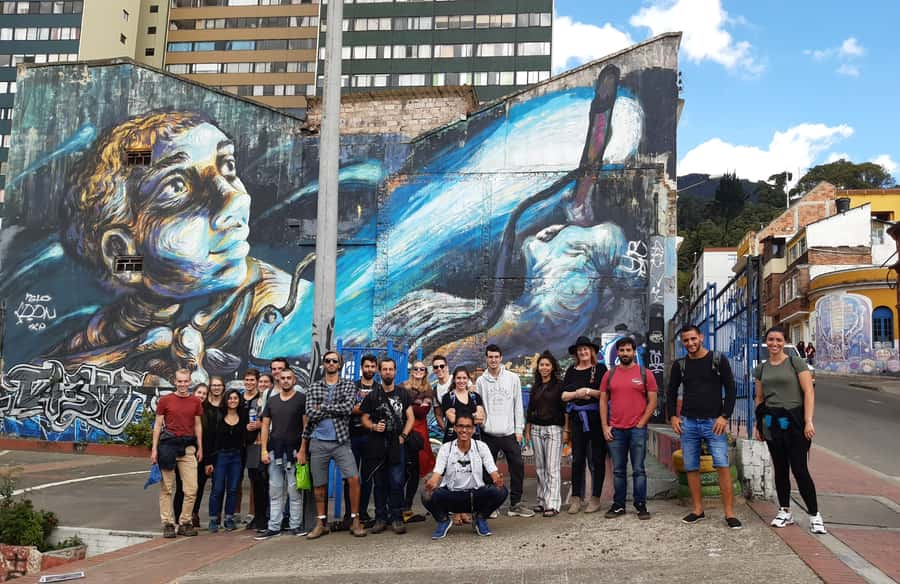
The itinerary gives roughly an hour to Journalist’s Park and the surrounding streets. Like La Concordia, this is presented as a place where people and ideas have met, helping shape the identity of downtown Bogotá.
That context adds a useful layer to the murals. Instead of treating each wall as a separate attraction, the guide shows how public spaces, political concerns, and local identity appear in the art. You may discuss current issues, environmental themes, indigenous identity, and the way artists respond to their city.
This section is especially useful for anyone who wants more than colorful photographs. A guide can point out small details, explain a symbol, or show how one artist’s approach differs from another’s. One guide has even used supplemental videos to explain the artists’ process and the making of particular murals.
The walk is leisurely enough for questions and photographs, but you should stay with the group. The tour specifically asks you not to wander away, which is sensible in a busy central district and also keeps the explanations together.
Women artists and a wider view of Bogotá’s art scene
A strong feature of this experience is its attention to women working in street art. The route includes artists such as Bastardilla, Vera, and Ledania, and the guide discusses their role in spreading and shaping the art form.
That matters because a quick self-guided walk can leave you with a narrow picture of Bogotá’s graffiti scene. You may notice the most dramatic wall first, but you might miss who made it, what perspective it presents, or how women artists have contributed to the city’s public art.
I appreciate that the tour treats artistic identity as part of the subject. You hear about the different ways artists work, the meanings behind their images, and the relationships between the artists and their surroundings. The result is a more rounded view of the scene than a simple list of famous walls.
If you are already familiar with street art, this part may be the most rewarding. It gives you names to research later and helps you recognize that Bogotá’s murals are not one single style.
Ending at Café Herencia with coca leaf tea
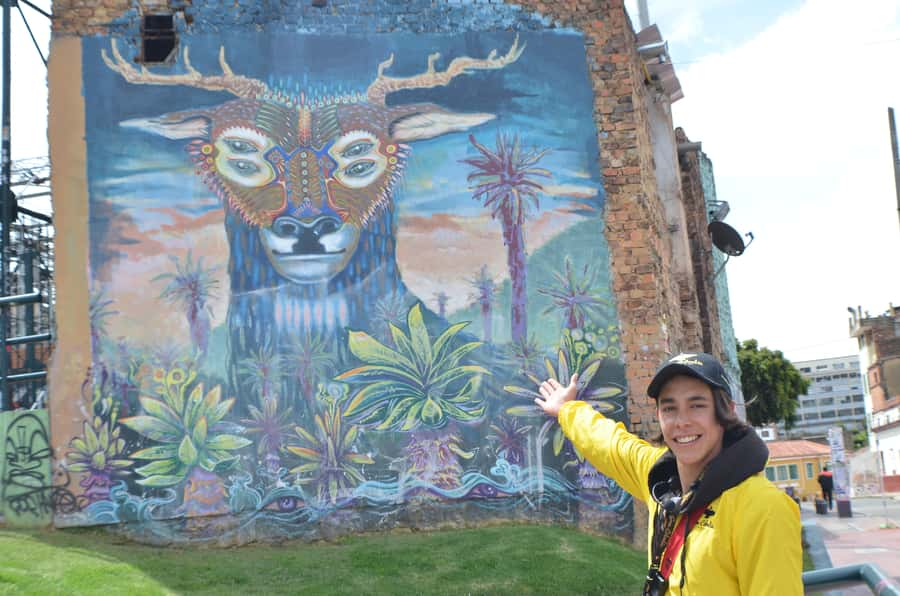
The walk returns to the Chorro de Quevedo area after a final photo stop in La Candelaria, then finishes at Café Herencia. There you receive a cup of coca leaf tea and a local treat.
The café is not just a convenient place to sit down. It works with and supports local artists, so the final stop keeps the focus on the people and creative life behind the murals. After two and a half hours on foot, having a drink in an art-minded café is a welcome ending.
Coca leaf tea is a distinctive part of the experience. The tour presents it as a Colombian tea tasting, and some departures have also included chicha and cocoa tea. Since the exact tasting can vary, it is best to expect the coca tea specifically and regard any additional drink as a possible extra.
This is a modest inclusion, but it adds local character. It also gives you a moment to ask a final question or continue the conversation with your guide and group rather than ending abruptly on a street corner.
What $16 buys you
At $16 per person, this is strong value if you want interpretation rather than a basic stroll. The fee covers a 150-minute guided walk, the socio-political background of Bogotá’s graffiti, several downtown art stops, the tea tasting, all-risk insurance, and an umbrella if rain starts.
The price is particularly reasonable for a small group capped at 10 people. You are paying for access to a guide’s local knowledge and for the time spent explaining works that may have no sign or label beside them.
The value is lower if you only want to photograph murals quickly. You could walk through La Candelaria on your own, but you would lose the artist names, political context, and explanation of indigenous themes that form the heart of this experience.
There are no transport costs included, so you need to make your own way to Chorro de Quevedo and away from the area afterward. That is not a serious drawback if you are already staying or sightseeing in central Bogotá, but it is worth allowing time for before and after the walk.
You can reserve and pay later, and cancellation is free up to 24 hours before the start for a full refund. Those terms are useful if your Bogotá plans may shift.
Language, pace, and practical preparation
The tour is offered in English and Spanish. The guide assigned to you may speak one language or both, and the tour can run in English and Spanish together depending on the group.
That is the main practical point to consider before booking. If you need a fast, detailed explanation in only one language, a mixed-language departure may feel slower. On the other hand, the bilingual format can work well if you enjoy hearing Spanish or want to practice it. One participant specifically found the guide’s communication helpful for improving Spanish skills.
Bring comfortable shoes, water, sunscreen, a camera, and clothing suited to the weather. Bogotá’s conditions can change, so the supplied umbrella is useful, but it does not replace a light rain layer or sun protection.
Keep your belongings close and remain with the group. The tour is a walking experience through central streets, not a closed museum visit, and staying together helps you hear the guide and avoid missing the next stop.
Who will enjoy this tour most
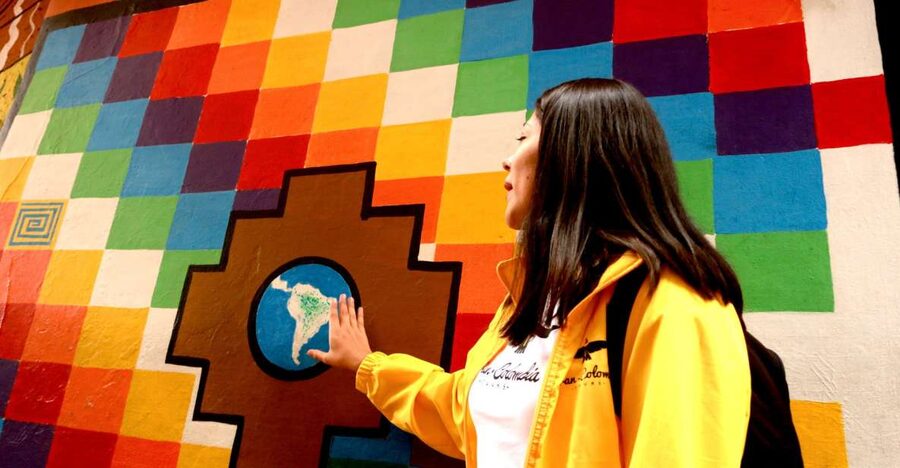
I would recommend it to first-time visitors who want an introduction to La Candelaria with more substance than a general sightseeing walk. It also suits anyone who chose Bogotá partly for its urban art and wants to understand the artists rather than simply collect photographs.
It works well for solo visitors because the small group creates an easy setting for questions. Couples, friends, and older children who can manage a 150-minute walk should also find the format approachable.
Art students, photographers, and people interested in politics or indigenous culture will have plenty to think about. The tour covers different styles and subjects, and it does not treat graffiti as an empty backdrop.
I would be less likely to recommend it if you dislike walking, want a private guide in one language only, or prefer a tour devoted entirely to market food. The La Concordia stop is brief, and the main subject is the meaning and setting of Bogotá’s street art.
Should you book the La Candelaria graffiti tour?
Book it if you want Bogotá’s murals explained, not just photographed. The combination of a 10-person limit, a 150-minute route, named local artists, social and political context, and coca leaf tea at Café Herencia gives you a lot for $16.
Choose the morning or afternoon departure that fits your plans, arrive at Chorro de Quevedo by the yellow umbrella, and prepare for weather and steady walking. If you can accept a bilingual group and want a thoughtful introduction to La Candelaria, this is an easy tour to justify.
FAQ
Where does the Bogotá graffiti tour begin?
It begins at Plazoleta del Chorro de Quevedo, beside the fountain by the yellow umbrella.
What time does the tour start?
Departures are available every day at 10 a.m. and 2 p.m.
How long does the experience last?
The tour lasts 150 minutes, or about two and a half hours.
Which languages are available?
The live guide service is available in English and Spanish. Depending on the group, both languages may be used during the same departure.
How many people can join the tour?
The small group is limited to 10 participants.
Is transportation included?
No. Transportation is not included, so you need to reach the meeting point and make your own arrangements afterward.
What is included at the end of the tour?
You receive a Colombian tea tasting, specifically coca leaf tea at Café Herencia.
Can I cancel the booking?
Yes. You can cancel up to 24 hours in advance for a full refund. You can also reserve now and pay later.
New street art tours in Colombia
- Comuna 13 Neighborhood & Street Art Private Tour★ 4.7 · 12 reviews
- Medellin: Graffiti Tour Comuna 13★ 4.1 · 14 reviews
- Medellín Comuna 13 local guides snacks and your own graffiti★ 4.9 · 13 reviews
- Graffiti Tour: a fascinating walk through a street art City★ 5.0 · 5 reviews
- Comuna 13: Recorrido de Arte Urbano, Cultura y Resiliencia★ 5.0 · 3 reviews
- Fun Graffiti Workshop: The Art of Aerosol and Color★ 5.0 · 3 reviews
- Comuna 13: Graffiti tour & Street Food/drink with telesferic★ 4.4 · 19 reviews
- Comuna 13: Graffiti Tour with Tasting, Live Show, & Gallery★ 5.0 · 4 reviews
Graffiti Tours, side by side.
Comuna 13 Graffiti Tour, Cable Car & Street Food
Read our review →

Brooklyn Graffiti & Street Art Walking Tour in Bushwick
Read our review →
Comuna 13 Tour with Snacks And Your Own Graffiti
Read our review →Lists this wall walk turns up in