
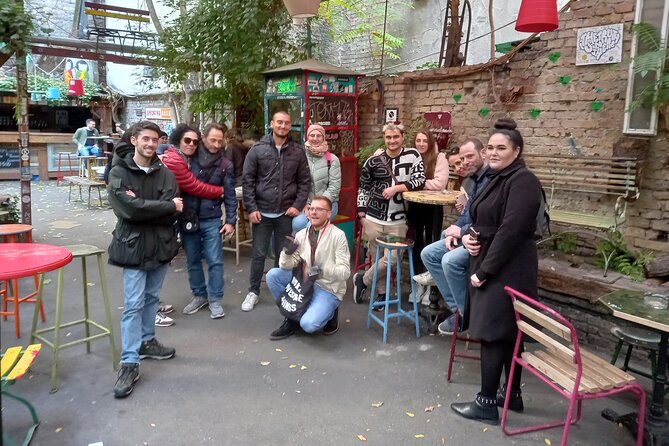
Reviewed · ALTERNATIVE AND HIDDEN CITY TOURS
Street Art and Alternative Tour in Budapest
Budapest’s street art is not limited to giant murals. The sharper discoveries are often small: a sticker on a utility box, a bronze figure, a pointed image, or a short message you would pass without seeing. This tour slows you down in District VII, where guide ET explains what these works mean and how politics, culture, and neighborhood change shape them.
I like the small group of no more than eight and the way the walk treats street art as more than decoration. I also like the ending at Szimpla Kert, Budapest’s oldest ruin bar and one of the city’s best-known symbols. The main consideration is simple: this is a walking tour on narrow streets, so you should be comfortable moving on foot for about two hours.
Key points to know before you book
- The art is wide-ranging: Expect murals, stickers, bronze sculptures, smart-art images, wall pieces, and small works that are easy to miss.
- Politics matters here: ET explains the social and political messages behind many pieces, not just their colors or design.
- The route is in District VII: You see a less polished, more local side of central Budapest.
- ET keeps it personal: His own connection to Budapest’s art scene gives the walk a direct, conversational feel.
- Eight people is the limit: The small group makes it easier to ask questions and discuss what you are seeing.
- The tour is in English: It lasts about two hours, begins at Telep-Art Galéria, and finishes at Szimpla Kert.
Budapest’s street art starts with looking closely
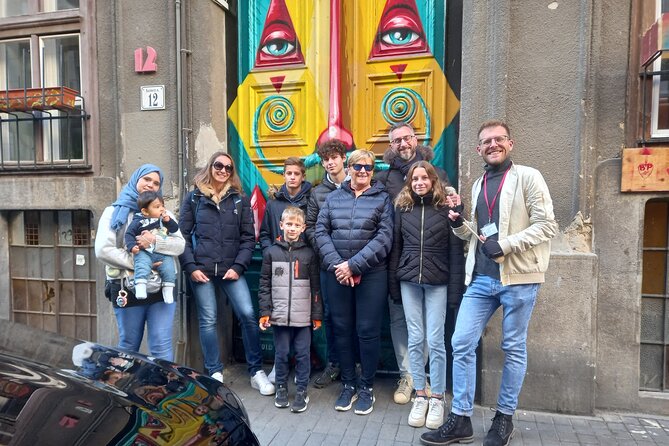
A normal walk through Budapest can leave you with the grand sights: the Danube, the Parliament, the bridges, and the old facades. This tour asks you to pay attention at eye level. You may stop beside a wall, a door, a utility box, or a narrow side street while ET points out a piece that could easily blend into the city.
That change in pace is the point. You are not racing from one famous sight to the next. You are learning where to look, how to read the work, and why the artist may have chosen that particular surface.
The art comes in several forms. Large murals are part of it, but they are only one part. The walk can include stickers, bronze sculptures, smart-art images, small painted pieces, and other street-level works. One of the most useful lessons is that Budapest’s creative scene is not defined only by beautiful paintings. Many works carry a message, make a political comment, or ask you to reconsider something happening in the city.
That makes this a good choice if you want more than a photo stop. You will still see attractive art, but the focus is on meaning and context.
More Alternative City Tours in the world:
- London Bike Tour: Landmarks, Secret Gems, Pub Stop & Street Art
★ 5.0 · 943 reviews - Budapest: Street Art and Underground Movements Walking Tour
★ 5.0 · 365 reviews - Berlin: Street Art and Alternative Tour
★ 4.7 · 98 reviews
Telep-Art Galéria is a fitting place to begin
The meeting point is Telep-Art Galéria at Madách Imre út 8. This gives the tour an art-centered start rather than beginning at a major monument or a standard sightseeing square.
From there, the walk moves into nearby narrow streets. The published route description is deliberately simple: you walk slowly while ET shows you many kinds of street art. That means you should not expect a rigid checklist of fixed monuments. The exact pieces discussed may change, and the conversation can respond to the interests of the group.
That flexible format is useful because street art changes. Stickers disappear, walls are painted over, and temporary works may not be in the same condition later. One particularly helpful detail is that ET has varied the tour for different groups, tailoring weekday walks to the people who attend. You may find that the discussion gives extra attention to politics, design, local history, or the wider European art scene, depending on the questions people ask.
The trade-off is that a flexible route offers less certainty than a traditional sightseeing tour. If you want a precise list of landmarks and an exact timetable at every stop, this may feel loose. If you enjoy conversation and discovery, that looseness is part of the appeal.
District VII reveals a different Budapest
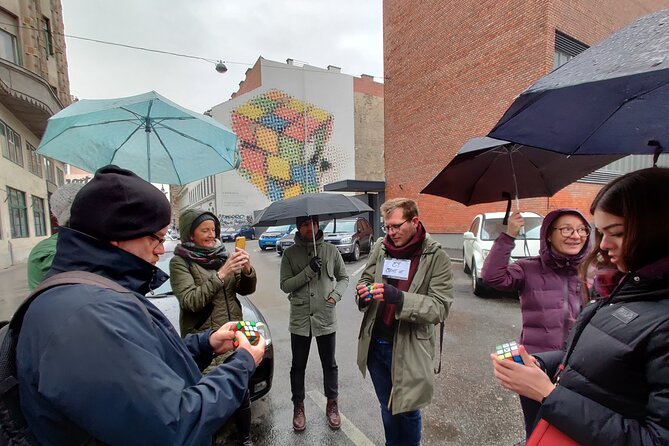
District VII, also known as the Jewish Quarter, is one of central Budapest’s most active areas for bars, restaurants, nightlife, and creative work. This tour looks past the most obvious attractions and shows you details that are easy to miss on your own.
You might pause over a sticker campaign, a small box transformed into an artwork, or a wall image that comments on public life. The pieces do not all aim to be pretty. Some are playful, some are critical, and some work more like short visual arguments.
The political side of the tour is especially important. ET explains how events and public debates in Budapest have influenced artists and the ways they express themselves. You are encouraged to think about who made the work, what it is reacting to, and how art can communicate in a crowded city.
That approach gives you a more useful view of the neighborhood. Instead of treating street art as background color, you begin to see it as part of a conversation about society and change. You may also continue noticing stickers, boxes, and small markings for the rest of your visit. The tour trains your eye, which is a lasting benefit for a two-hour activity.
ET brings the art scene into the conversation
ET is the guide named throughout the experience, and his connection to Budapest’s art scene shapes the walk. He explains the work with enthusiasm and adds context about the area and the artists. He also draws on knowledge of European street artists, which can help place Budapest’s work in a wider setting.
The strongest part of his style is the interactive element. You are not simply listening to a speech while walking behind a guide. You can ask questions, discuss the message of a piece, and compare how different people interpret the same image.
That matters because street art is rarely clear-cut. A mural may have one obvious subject but several possible meanings. A sticker may be humorous, political, or deliberately obscure. ET’s approach allows room for that uncertainty instead of forcing every piece into one correct answer.
The guide also pays attention to what visitors would normally miss. This is particularly valuable early in your Budapest stay, when you are still learning how the city is organized and how its creative communities express themselves. The tour can give you a useful first look at local culture before you spend more time exploring on your own.
More street art tours worth booking in the world:
- Medellin: Comuna 13 Graffiti Tour, Cable Car & Street Food
★ 4.8 · 9,046 reviews - CDMX: Xochimilco, Coyoacan, Frida Kahlo Museum & Murals Tour
★ 4.4 · 3,025 reviews - Amsterdam: Streetart Museum STRAAT Entrance Ticket
★ 4.8 · 2,137 reviews - Belfast: Murals Taxi Tour
★ 4.9 · 2,047 reviews
Expect more than large murals
If you book this walk expecting two hours of giant painted walls, adjust your expectations. The larger works are part of the experience, but the tour also includes tiny and easily overlooked pieces.
The range may include:
- Large-scale wall murals
- Stickers and sticker campaigns
- Bronze sculptures
- Smart-art images
- Painted or altered utility boxes
- Small street pieces with political or social messages
This variety keeps the walk from becoming repetitive. You may go from discussing a carefully planned mural to examining a tiny sticker placed on an ordinary surface. The scale changes, the materials change, and the meaning changes.
For some people, that is the best part. You start to understand that street art is not a single style. It can be handmade, digital, sculptural, temporary, decorative, humorous, or sharply political.
For others, the small pieces may feel less satisfying than the major murals they expected. The tour works best if you are willing to slow down and consider the idea behind a work, even when the object itself is modest.
The two-hour pace keeps the focus sharp
The experience lasts about two hours. That is long enough to explore several streets and discuss a good range of work without turning the outing into an all-day commitment.
The pace is described as slow, which is important. You will stop often, look carefully, and listen to explanations. This is not a fast city walk designed to cover a great deal of ground.
You should wear comfortable shoes and plan for regular walking on city streets. The walk is suitable for most people, and service animals are allowed. It is near public transportation, which makes reaching the start point easier, although the available information does not specify a particular metro or tram stop.
The limited group size is a real advantage. With no more than eight people, you can hear the guide more easily, ask questions without holding up a large crowd, and take part in the discussion. A larger group could make the same route feel less personal, especially when everyone is trying to gather around a small sticker or narrow wall.
Ending at Szimpla Kert adds a useful final stop
The route finishes at Szimpla Kert on Kazinczy Street. Szimpla Kert is described as Budapest’s oldest ruin bar and one of the city’s symbols.
The ending works well because the neighborhood’s alternative art, nightlife, and creative energy connect naturally with the ruin bar setting. You are not finishing at an anonymous street corner. You end at a recognizable Budapest address where you can continue your evening if you choose.
Do not assume that the tour includes a drink, food, or a formal visit inside the bar. The stated end point is Szimpla Kert, so treat it as a convenient place to finish rather than an included bar experience.
It is also a practical ending for your day. You can remain in District VII, explore more streets, or use the area as a base for dinner and nightlife. If you prefer quiet streets and an early evening, you can simply leave from there.
What the $36.20 price gets you
At $36.20 per person, the value depends on how much you want from a guide-led cultural walk. You are paying for about two hours with an English-speaking guide, a small group, and access to interpretation you would be unlikely to get from a casual self-guided stroll.
You could walk through District VII for free, of course. You might see some of the same murals and stickers. The difference is that you would probably miss many of the smaller works and would have little context for their political or social messages.
For someone who already follows street art closely, the price may feel less necessary if you prefer exploring alone. But if you want to understand what you are seeing, the guide’s input makes the cost more reasonable.
The group cap also helps the value. Eight people is small enough for an actual exchange rather than a one-way lecture. That is especially useful on a tour where interpretation is central and the meaning of a piece may be open to discussion.
The fact that the experience is often booked about 25 days ahead suggests that you should plan early if your dates are fixed. That is not a promise of availability, but it is a useful planning signal for a tour with a small capacity.
Who will enjoy this walk most
I would choose this for anyone who wants to see Budapest from a less conventional angle. It is especially suitable for:
- People interested in street art, design, stickers, and murals
- Visitors curious about political expression and social issues
- First-time visitors who want a different introduction to District VII
- Repeat visitors who have already seen Budapest’s main sights
- Families who are comfortable with two hours of walking
- Solo visitors who enjoy meeting a small group and discussing art
- Creative people who want to learn about Budapest’s local art scene
The tour is also a good choice for people who do not consider themselves art experts. You do not need a background in art to take part. The format is based on looking, asking questions, and discussing what you see.
It may be less suitable if you want a seated activity, a major-museum tour, or a route centered on famous buildings. It is also not ideal if you dislike uncertain meanings or prefer a fast schedule with many stops.
Practical details that matter
The tour is offered in English and uses a mobile ticket. Confirmation is provided when you book. The meeting point is Telep-Art Galéria, Madách Imre út 8, Budapest 1075.
The stated end point is Szimpla Kert, Kazinczy u. 14, also in District VII. Check the meeting details carefully before setting out, and allow enough time to arrive at the gallery.
Most people can participate, and service animals are allowed. The activity is near public transportation. Since the route involves walking through narrow streets, comfortable footwear will make the experience easier.
You can cancel for a full refund if you do so at least 24 hours before the start time. Cancellations or changes made less than 24 hours before the start are not accepted for a refund. The cut-off follows local Budapest time.
Should you book the Budapest street art tour?
Book it if you want a small, discussion-based walk that explains the ideas behind Budapest’s street art. ET’s enthusiasm, the political context, and the range of work make this more than a mural photo hunt.
I would especially recommend it early in your stay. Once you learn where to look, the city’s walls, boxes, stickers, and small objects become more interesting for the rest of your visit.
Skip it if your priority is a traditional sightseeing route, a short stroll, or a guaranteed list of major murals. But if you like art with a point of view and do not mind walking slowly through District VII, $36.20 buys a thoughtful introduction to a side of Budapest that is easy to miss.
FAQ
Where does the Street Art and Alternative Tour in Budapest start?
The tour starts at Telep-Art Galéria, Madách Imre út 8, Budapest 1075, Hungary.
Where does the tour finish?
The tour finishes at Szimpla Kert, Kazinczy u. 14, Budapest 1075. Szimpla Kert is described as Budapest’s oldest ruin bar and one of the city’s symbols.
How long does the tour last?
The tour lasts approximately two hours.
What language is the tour offered in?
The tour is offered in English.
How many people can join the tour?
The group is limited to a maximum of eight people.
What kinds of street art will I see?
The walk can include murals, stickers, bronze sculptures, smart-art images, small street pieces, and altered boxes or other overlooked details.
Can I cancel for a full refund?
Yes. You can cancel at least 24 hours before the start time for a full refund. Cancellations or changes made less than 24 hours before the start time are not accepted for a refund.
New street art tours in the world
- Your Own Belgrade: Street Art and Hidden Gems Walking Tour★ 5.0 · 2 reviews
- Wynwood Walls Street Art & Neighborhood Walking Tour★ 4.9 · 9 reviews
- Xochimilco floating gardens, Coyoacan and UNAM murals★ 4.0 · 6 reviews
- Vancouver: Street Art & Craft Beer Walking Tour with Tasting★ 4.8 · 14 reviews
- Vancouver: Street Art & Craft Coffee Walking Tour w/ Tasting★ 4.8 · 11 reviews
- Zagreb Street Art Private Walking Tour with a Local Artist★ 5.0 · 12 reviews
- UNAM: Murals & Revolution★ 4.9 · 8 reviews
- Urban Canvas: Osaka Street Art Bike Tour★ 5.0 · 10 reviews
Alternative and Hidden City Tours, side by side.
London Bike Tour: Landmarks, Secret Gems, Pub Stop & Street Art
Read our review →
Street Art and Underground Movements Walking Tour
Read our review →

San Antonio E-Bike Tour: Murals, Street Art and Hidden Gems
Read our review →
Amsterdam’s Hidden Gems and Street Art Bike Tour
Read our review →
Alternative Street Art Free Walking Tour of Budapest
Read our review →
Street Art and Alternative Tour of Berlin in French
Read our review →Lists this wall walk turns up in