
Reviewed · HISTORICAL TOURS
Bishkek Street Murals , Mosaics Arts and Kyrgyz Nomadic History
Bishkek’s street art makes more sense when you know the story behind it. This walking tour links Soviet mosaics and modern murals with Kyrgyz legends, nomadic life, public monuments, and the city’s broad central squares. Alex guides you from Ala-Too Square through several notable works, including a mural about litter, art tied to Chinghiz Aitmatov’s The Red Apple, and pieces by the local DOXA artist group.
I like the way the walk moves between major landmarks and less obvious art rather than treating murals as isolated photo stops. I also like the clear focus on meaning: you learn why a work was made, not just where it is. The main drawback is pace. Nearly three hours on foot, with several 25 to 35 minute stops, may feel long if you want a quick introduction to Bishkek or prefer riding between sights.
Key points to know before you book
- Soviet mosaics meet present-day street art: The route shows how public art changed from state-era messages to newer work about Kyrgyz identity, sport, film, and city life.
- Ala-Too Square sets the historical stage: You begin with Manas, national symbols, and the architecture of Bishkek’s central civic area.
- Alex adds the stories behind the images: The tour is built around explanation, especially the links between art, Kyrgyz culture, and the Soviet period.
- The walk includes major central landmarks: You pass the Opera and Ballet Theatre, GUM Chynar Mall, the Sunny Fish fountain, and the Philharmonic Hall.
- The group is capped at 15 people: That is small enough for a more personal walking experience, though the exact feel depends on the final group.
- The $45 price buys context as much as sightseeing: All listed fees, guiding, and city or country recommendations are included, but insurance is not.
Why Bishkek’s murals are worth your walking time
Bishkek can look broad and formal at first glance. Wide avenues, generous squares, Soviet-era buildings, statues, and fountains give the center a planned appearance. The murals add another layer, one that is harder to read without local explanation.
This tour treats public art as a record of changing ideas. The older mosaics reflect Soviet themes and official messages. Newer murals bring in environmental concerns, sport, film, local artists, and Kyrgyz cultural references. That contrast is the central reason to book the walk.
I like this approach because it gives you a way to read Bishkek rather than simply photograph it. A mural may seem decorative until you learn its subject, its political setting, or its connection to a local story. The tour also places modern art beside formal landmarks, so you can see how the city presents its past and present in the same few blocks.
The experience lasts about 2 hours and 45 minutes. That is long enough to form a useful picture of central Bishkek, but it is still a single walking outing rather than a full-day city tour. You return to the starting point, which makes it easier to fit the walk into a larger sightseeing plan.
More history behind the walls in the world:
- 3-Hour Atlanta Beltline Food, Street Art and History Tour
★ 5.0 · 345 reviews - History and Murals: Walking Tour Guadalajara
★ 5.0 · 237 reviews - Walking Tour – Impressive murals in Historical Center of Mexico City
★ 5.0 · 224 reviews
Starting at Ala-Too Square with Manas
The route begins at Ala-Too Square, the main civic center of Bishkek. This is a sensible starting point because the square introduces the country’s public symbols before you move into the art itself.
Here you learn about the historical features of Kyrgyzstan and the place of Manas, the Kyrgyz hero whose name is central to national identity. The opening stop lasts about 15 minutes and has no admission charge.
I would pay close attention to the explanation at this point, even if you are most interested in murals. The later works make more sense once you have a basic idea of how Kyrgyz identity is presented in public spaces. The square also gives you a quick look at the scale of central Bishkek, with its large open civic setting and prominent architecture.
This is not a museum visit, so expect an outdoor introduction rather than displays or indoor exhibits. Depending on the weather, sun and walking conditions may affect your comfort. Wear shoes suited to nearly three hours on city streets.
Kurmanzhan Datka and an early Soviet mosaic
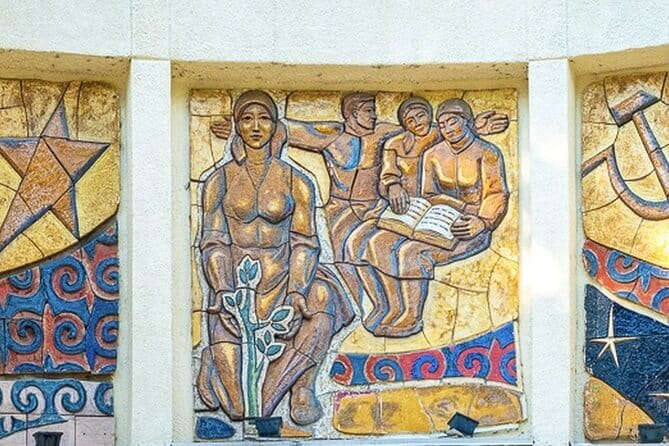
The next stop is near the Kurmanzhan Datka statue and the Ala Too Theatre. The stop lasts about 25 minutes and focuses on an important Soviet-era mosaic described as one of the first meaningful mosaic artworks made for the nation.
The subject is peace between two nations after a century of conflict. That theme gives the artwork more weight than its size or design alone might suggest. You are not simply looking at colored tiles on a wall. You are considering how Soviet public art used large, permanent images to teach shared political and social values.
Kurmanzhan Datka is also an important Kyrgyz historical figure, so this part of the route connects national memory with the Soviet period. That pairing is useful. It shows that Bishkek’s public spaces do not tell only one story. Kyrgyz figures and Soviet-era messages can appear within the same central district.
This is one of the stops where Alex’s explanations matter most. Without context, a mosaic can be easy to pass by. With the story behind its subject, you can look for the message, symbols, and intended audience.
The 1926 Opera and Ballet Theatre
The walk then continues to the Kyrgyz National Opera and Ballet Theatre, built in 1926. You spend about 15 minutes here, looking at the building’s architecture and the statues on its roof.
This stop changes the rhythm of the tour. Instead of studying a mural, you are looking at a formal cultural building and its decorative details. The theater helps show how central Bishkek was shaped by Soviet planning and public institutions. Its age also gives you a fixed point for understanding the city’s architectural development.
I would not expect a full theater visit or performance. The attraction here is the exterior, including the building design and rooftop statues. If you enjoy architectural details, this is a useful pause. If your main goal is street art, it is still worthwhile because it keeps the mural stops tied to the wider city rather than placing them in isolation.
The tour’s mix of architecture, monuments, fountains, and murals is one of its strengths. You get a more complete sense of the city center than you would from a mural-only walk.
More street art tours worth booking in the world:
- Medellin: Comuna 13 Graffiti Tour, Cable Car & Street Food
★ 4.8 · 9,046 reviews - CDMX: Xochimilco, Coyoacan, Frida Kahlo Museum & Murals Tour
★ 4.4 · 3,025 reviews - Amsterdam: Streetart Museum STRAAT Entrance Ticket
★ 4.8 · 2,137 reviews - Belfast: Murals Taxi Tour
★ 4.9 · 2,047 reviews
GUM Chynar Mall and Slam Dunk on Trash
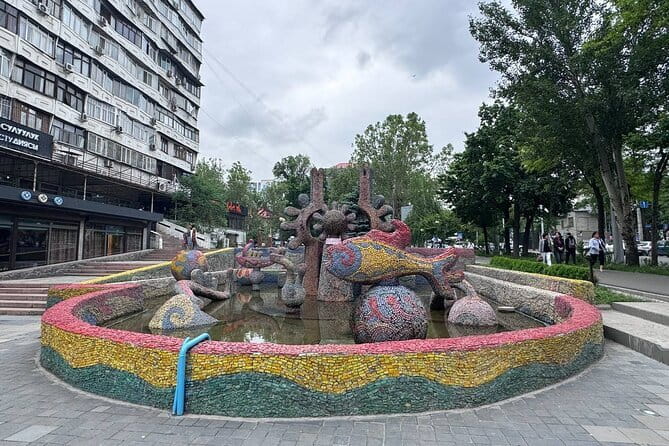
The route passes GUM Chynar Mall, a modern shopping center in the city center, before reaching the mural Slam Dunk on Trash. The stop lasts about 25 minutes.
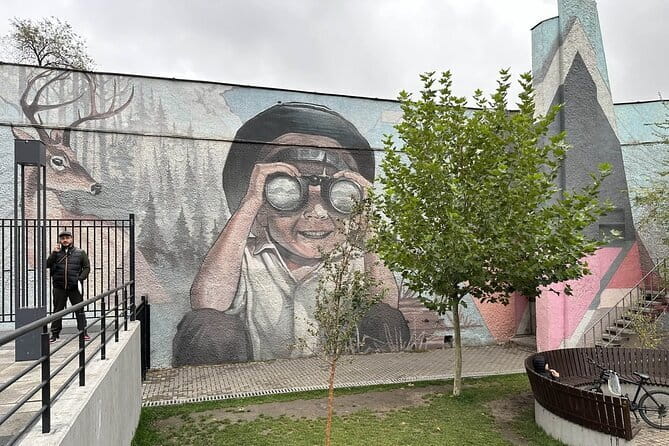
The mural’s idea is direct: putting litter into a bin should be treated like a successful basketball slam dunk. It is a playful environmental message, and the sporting reference makes the point easy to grasp. The work also gives you a look at how newer public art can comment on ordinary city problems rather than grand national themes.
This stop is a good example of the tour’s range. The earlier mosaic carries a formal message about peace and nations. Slam Dunk on Trash speaks in a more casual visual language about keeping Bishkek clean. You can compare the tone, purpose, and style of the two works within the same walk.
The mall adds a modern commercial note, but it is not presented as a shopping excursion. You pass through this part of the city to see how new development and public art share the central streets. If you want time to shop, browse, or stop for a drink, confirm the plan with Alex, since the scheduled walk continues through several more stops.
The Sunny Fish fountain and Aisuluu Tynybekova
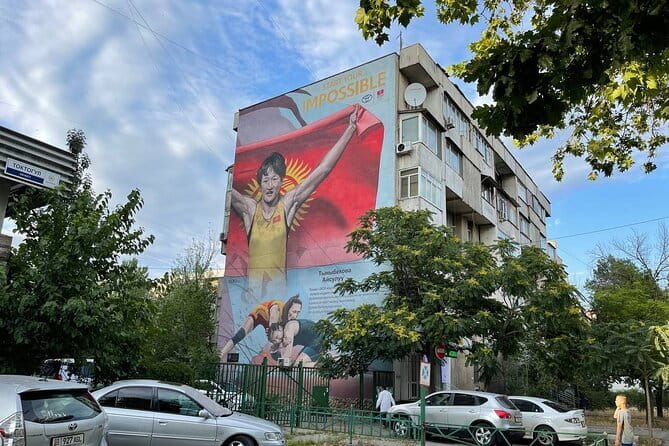
The next section takes about 15 minutes and leads toward the Sunny Fish fountain. Along the way, you see a reference to Aisuluu Tynybekova, the Kyrgyz wrestler who won a silver medal at the 2022 Tokyo Olympics.
The fountain dates to 1982 and was built by Russia, according to the tour information. Its age makes it another useful example of the city’s Soviet public art and civic design. Compared with the newer murals, the fountain belongs to a different visual and political period.
The mention of Tynybekova brings the present day into that older setting. Sport becomes another thread linking Kyrgyz public life across generations. The route does not treat the city as frozen in Soviet times. Instead, it places older structures beside current national figures and recent artistic references.
This is a shorter stop, so you should expect a focused explanation rather than a long break. The fountain may be most useful to you as part of the larger comparison between eras. Look at how public space is used for decoration, civic identity, and storytelling.
The Red Apple mural and Chinghiz Aitmatov
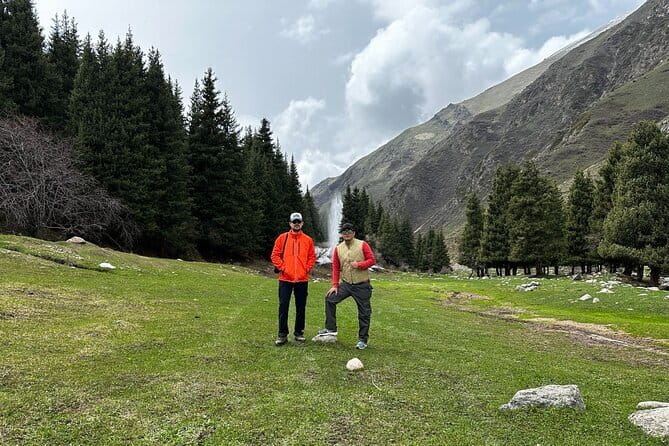
One of the longer stops, at about 35 minutes, focuses on graffiti connected with Chinghiz Aitmatov’s short story and the film The Red Apple. The film entered the ninth Moscow International Film Festival, giving the work a link to both Kyrgyz literature and Soviet cinema.
This stop is likely to appeal most if you enjoy stories behind art. The mural is not simply a picture chosen for color or scale. It draws from a known Kyrgyz literary and film reference, so Alex’s explanation helps you understand what you are seeing and why that subject matters.
Chinghiz Aitmatov is a major name in Kyrgyz cultural life, and this stop gives the walking tour a more personal and narrative tone. You move from public messages about nations, peace, and cleanliness to a work shaped by literature and film.
The 35-minute duration tells you to expect a detailed conversation here. If you have read Aitmatov or seen The Red Apple, you may get more from the stop. If you have not, you can still follow the basic connection through the guide’s explanation, though this part may feel more specialized than the broad city landmarks earlier in the route.
DOXA’s murals and the Kyrgyz State Philharmonic Hall

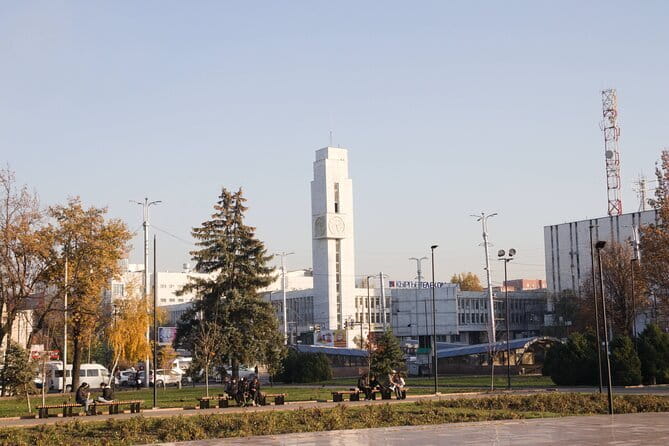
The final section takes you past three more graffiti works by the Kyrgyz artist group DOXA before reaching the Kyrgyz State Philharmonic Hall. This portion also lasts about 35 minutes.
The DOXA works are presented as pieces that represent Kyrgyzstan and Bishkek in a direct, current way. After seeing the older mosaic and the 1982 fountain, you can compare them with the style and subjects of these newer works. That comparison is the main payoff of the tour.
The Philharmonic Hall gives the route another major civic building as its closing point. Like the Opera and Ballet Theatre, it shows how the city’s cultural institutions shape the central streets. The difference is that the walk has now taken you through several layers of time before arriving there.
The route ends back at the meeting point rather than leaving you across town. That is practical, especially if you have arranged a hotel visit, meal, or another activity near the center. The final stretch is not a grand finale in the conventional sightseeing sense. It is a last chance to connect the murals with the city’s main public buildings.
What the $45 price includes
The cost is $45 per person. That is not the price of a simple orientation walk, since the tour spends significant time explaining individual artworks and their cultural setting.
Your fee includes the guided tour and all listed fees and taxes. You also receive free recommendations for Bishkek or elsewhere in Kyrgyzstan, which can be useful if this is one of your first activities in the country. Alex’s local perspective may help you decide what to see next, though the information provided does not specify the exact form or length of those recommendations.
The value depends on how much you want interpretation. If you only want quick photographs of central landmarks, you may find the cost high for a walk that lasts nearly three hours. If you want to understand the meaning behind Soviet mosaics, modern graffiti, Kyrgyz figures, and literary references, the guide adds the part you cannot get from passing by alone.
Group discounts are available. The maximum group size is 15 people, which keeps the walk from becoming a large coach-style outing. Insurance is not included, so you need to arrange that separately if you want coverage.
Timing, meeting point, and walking comfort
The meeting point is VJG3+MFG on Chuy Avenue in Bishkek. The walk ends back at the same meeting point. A mobile ticket is available, and confirmation is provided at booking.
The activity is generally open to most people, according to the supplied participation information. Still, the route lasts 2 hours and 45 minutes and includes several walking sections, so you should judge your own comfort with extended time on foot. The information does not give a detailed accessibility description, so contact the provider if you need specific assistance.
Because the tour is booked on average 30 days ahead, it is sensible to reserve before your arrival if the schedule matters. Free cancellation is available up to 24 hours before the start time. Inside that 24-hour window, the payment is not refunded and changes are not accepted.
Who should book this Bishkek art walk
I would recommend this tour to you if you like city walks that explain what you are looking at. It suits first-time visitors who want an introduction to central Bishkek, as well as returning visitors who want a cultural angle beyond the usual squares and monuments.
It is especially useful if you are curious about the Soviet period but do not want a tour limited to Soviet buildings. The route shows how that era remains visible in mosaics, fountains, theaters, and city planning, then sets those elements beside new murals and modern Kyrgyz references.
You may want to skip it if you dislike long walking tours, want extensive indoor sightseeing, or prefer to explore at your own pace. The itinerary has a set structure, and the 25 to 35 minute stops mean the experience is built around listening and discussion rather than quick snapshots.
Should you book it?
Book this walk if you want Bishkek’s public art explained through Kyrgyz culture, Soviet history, literature, and everyday city life. The strongest feature is the connection between the works, from a peace-themed mosaic to Slam Dunk on Trash, The Red Apple, and DOXA’s graffiti.
The $45 price is fair for a small-group guided walk with this much interpretation, provided you value context more than a simple landmark checklist. Choose another activity if you need a short, relaxed stroll. For a thoughtful first look at Bishkek, Alex’s route gives you a useful way to read the city’s walls, squares, fountains, and cultural buildings.
FAQ
How long does the Bishkek street art tour last?
The tour lasts approximately 2 hours and 45 minutes.
Where does the tour begin?
It begins at VJG3+MFG on Chuy Avenue in Bishkek, Kyrgyzstan.
Where does the tour end?
The activity ends back at the meeting point.
How much does the tour cost?
The listed price is $45 per person.
What is included in the price?
The price includes a guided tour, all listed fees and taxes, and free recommendations for Bishkek or Kyrgyzstan.
Is insurance included?
No. Insurance is not included in the tour price.
How large is the group?
The tour has a maximum of 15 travelers.
Is a mobile ticket available?
Yes. The activity offers a mobile ticket.
Can most people participate?
The additional information says that most travelers can participate. Specific accessibility details are not provided.
What is the cancellation policy?
You can cancel up to 24 hours before the start time for a full refund. Cancellations or changes made less than 24 hours before the start time are not accepted, and the amount paid is not refunded.
New street art tours in the world
- Your Own Belgrade: Street Art and Hidden Gems Walking Tour★ 5.0 · 2 reviews
- Wynwood Walls Street Art & Neighborhood Walking Tour★ 4.9 · 9 reviews
- Xochimilco floating gardens, Coyoacan and UNAM murals★ 4.0 · 6 reviews
- Vancouver: Street Art & Craft Beer Walking Tour with Tasting★ 4.8 · 14 reviews
- Vancouver: Street Art & Craft Coffee Walking Tour w/ Tasting★ 4.8 · 11 reviews
- Zagreb Street Art Private Walking Tour with a Local Artist★ 5.0 · 12 reviews
- UNAM: Murals & Revolution★ 4.9 · 8 reviews
- Urban Canvas: Osaka Street Art Bike Tour★ 5.0 · 10 reviews
Historical Tours, side by side.
Walking Tour – Impressive murals in Historical Center of Mexico City
Read our review →
Private Political History & Murals Tour Belfast
Read our review →
2-Hour Food, History and Street Art Tour of Ponce City Market
Read our review →
Historical Shared Tour Salsa, Graffiti & Resistance in Cali
Read our review →
Street Art: The Modern History of the Northern Quarter
Read our review →
Walking Tour of Houston: History, Architecture, Street Art
Read our review →
Beltline Food, Street Art, and History Walking Tour
Read our review →Lists this wall walk turns up in