
Reviewed · STREET ART BIKE TOURS
Madrid: Street Art Bike Tour
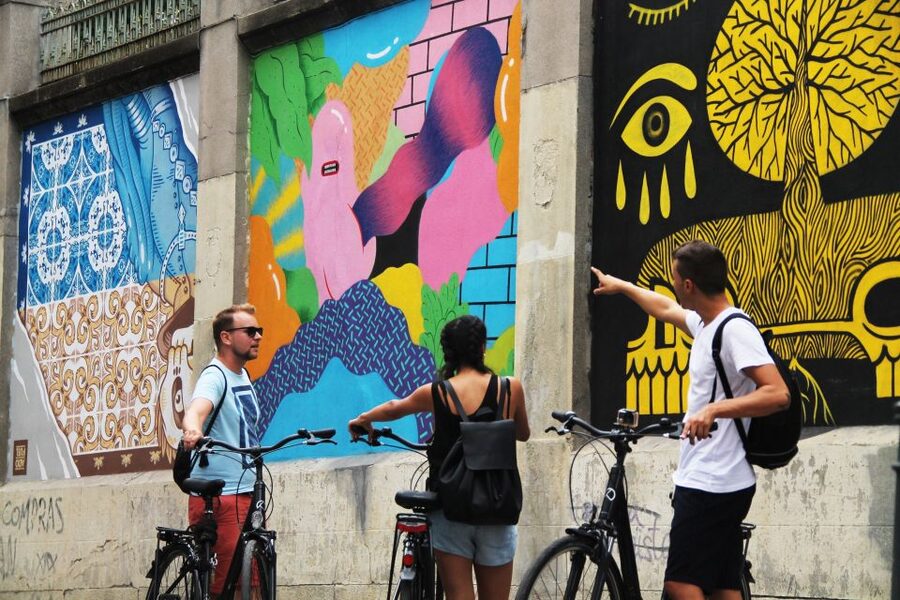
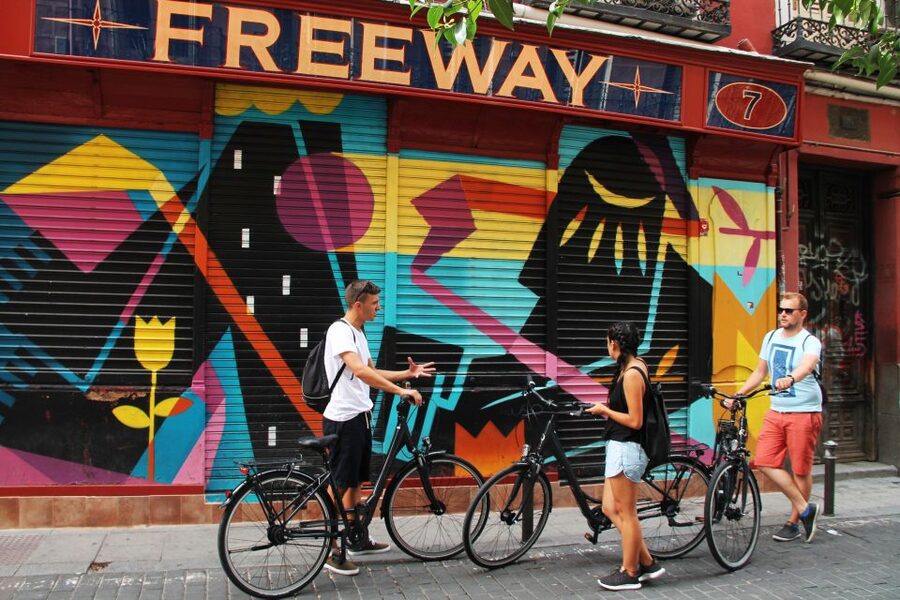
Madrid’s street art makes the most sense when you see it in the neighborhoods that produced it. This 2.5-hour bike tour links Madrid’s graffiti past with its current creative scene, from Muelle’s preserved 1989 tag to large festival works and painted shutters.
I like two things right away: you ride with a local graffiti artist, and the route reaches places that are easy to miss on a standard city tour. You also visit community-built spaces in Malasaña and Lavapiés, where art is tied to gardens, local projects, and daily life.
The main caution is the cycling. Madrid traffic, city streets, and one uphill section can challenge anyone who rarely rides in towns. The activity is described as medium level, and one rider found that less confident cyclists had a harder time keeping comfortable in traffic.
- Muelle’s 1989 tag: See one of the few preserved marks linked to Madrid’s early graffiti movement.
- Festival art in Malasaña: Visit work from Pinta Malasaña, including the playful Bolardo Voy, Bolardo Vengo installation.
- A guide who works in graffiti: Learn how artists use walls, metal shutters, and other city surfaces.
- Community spaces in Lavapiés: Cycle to Solar Antonio Grilo and Esto es una Plaza, former abandoned sites now used by local communities.
- Boa Mistura’s early work: Stop near Alonso Martínez to photograph an early piece by the Madrid-born creative crew.
- A practical city ride: Bike rental, helmet, lock, map, restroom break, and English or Spanish guiding are included.
Madrid’s Graffiti Story Begins with Muelle
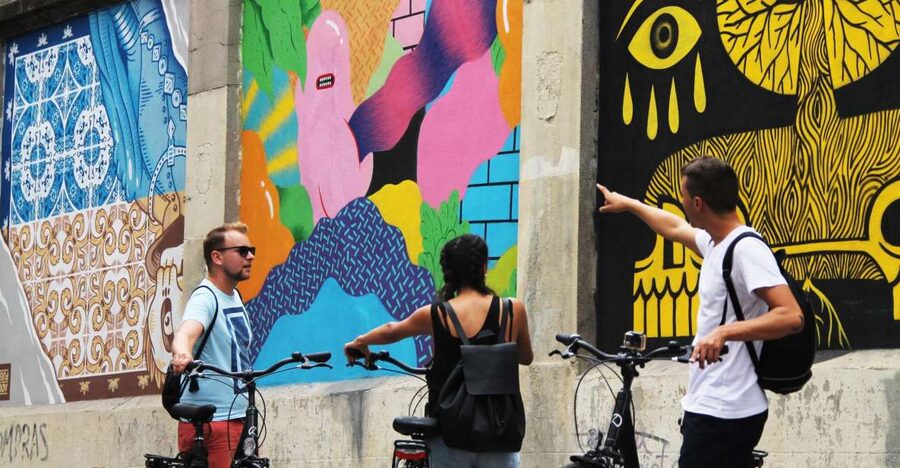
The tour opens with context before the riding gets serious. You learn how street art developed in Madrid and how artists use different surfaces and techniques, including walls, metal shutters, and other parts of the built city.
The key early figure is Muelle, whose name means spring, as in a mattress spring. He was a young Madrid artist linked to the city’s first graffiti movement, and the tour includes a tag preserved from 1989. That small mark matters because it gives you a fixed point in a story that can otherwise feel temporary. Murals change, shutters are repainted, and entire walls can disappear. Muelle’s surviving signature lets you look at Madrid’s street art as a living record rather than just a collection of colorful pictures.
I like this opening because it avoids treating every painted wall as the same. You get a little vocabulary and background before seeing the larger works, which helps you notice the difference between a tag, a mural, a design intervention, and a community art project.
After this first section, the guide explains bicycle safety. You receive a bike, helmet, lock, and Madrid city map, then set off toward Alonso Martínez. The route is not a relaxed park ride. You need to be comfortable steering, stopping, and paying attention around city traffic.
Alonso Martínez and the First Boa Mistura Stop
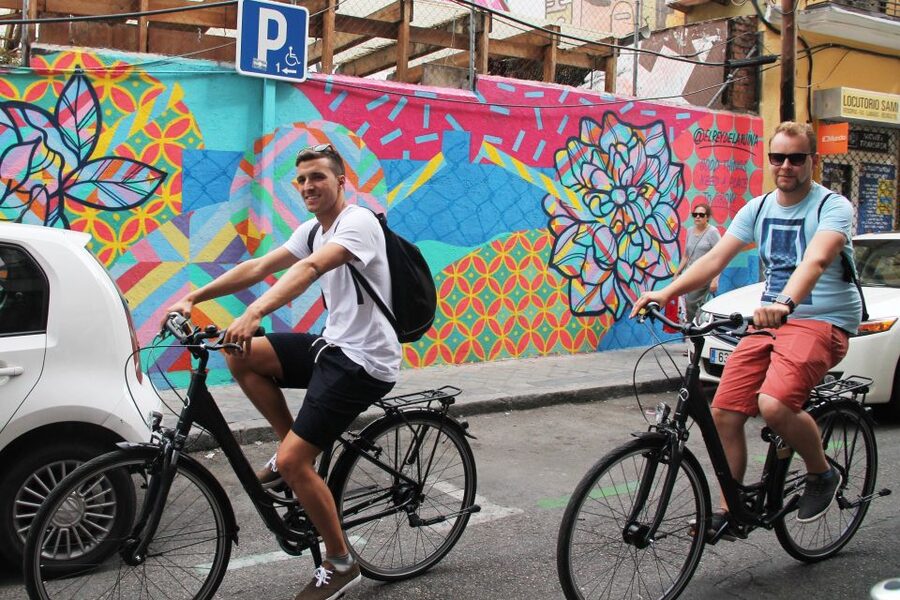
The first major ride takes you toward Alonso Martínez, where you stop to photograph an early work by Boa Mistura. This crew grew up on the outskirts of Madrid and later worked on street-art projects in different parts of the world.
The stop gives you a useful contrast with Muelle. His preserved tag represents an earlier, more individual form of graffiti. Boa Mistura’s work points toward a more organized design approach, with larger projects and a public-facing identity. Your guide can explain how Madrid’s scene developed from personal signatures into crews, festivals, and large-scale commissions.
This is also a good place to understand why a bike works well for this tour. The city’s art is spread across several neighborhoods, and riding lets you connect the pieces rather than seeing one isolated wall and then taking the metro away. You cover ground without turning the day into a long transport exercise.
Still, do not expect a private photo stop at every work. You are moving through city streets, and the exact pace depends on the group and traffic. If you want plenty of time to study each image, ask the guide questions as you go.
More Street Art Bike Tours in Spain
- Barcelona Street Art and Graffitti Bicycle Tour
★ 5.0 · 361 reviews - Valencia: Street Art Tour on Bicycle, E-Bike or E-Step
★ 4.8 · 31 reviews - Bilbao: Street Art Small Group E-Bike Tour
★ 4.8 · 23 reviews
Malasaña’s Festival Walls and Plaza Dos de Mayo
From Alonso Martínez, the route heads into Malasaña, one of Madrid’s trendiest areas. The neighborhood is closely associated with Pinta Malasaña, a street-art festival that fills local spaces with new work during April.
The tour includes pieces by Spanish artists who took part in the 2017 edition. Since street art can change, the exact condition of individual works may vary. The valuable part is the setting: you are seeing art within a neighborhood where shops, bars, streets, and local culture all form part of the picture.
Plaza Dos de Mayo is the focus of this section. The square is connected with the festival, and you see Bolardo Voy, Bolardo Vengo, a colorful treatment of traffic posts and other ordinary street elements. It is a good reminder that street art does not need a blank wall. Artists can turn the objects you normally ignore into part of the visual character of a place.
I especially like this stop for readers who want something less formal than Madrid’s major museums. You are not being asked to admire art in silence or study a label. You are looking at works where people actually live and move, with the city using the art as part of its everyday setting.
Malasaña is also the point where the tour may feel busiest and most demanding on a bicycle. Streets can be tight, and you must stay alert. If you are an uncertain cyclist, tell the guide early. The guide has adjusted the pace to help riders before, but your comfort will depend partly on your own city-riding experience.
Solar Antonio Grilo and the Work of Local Communities
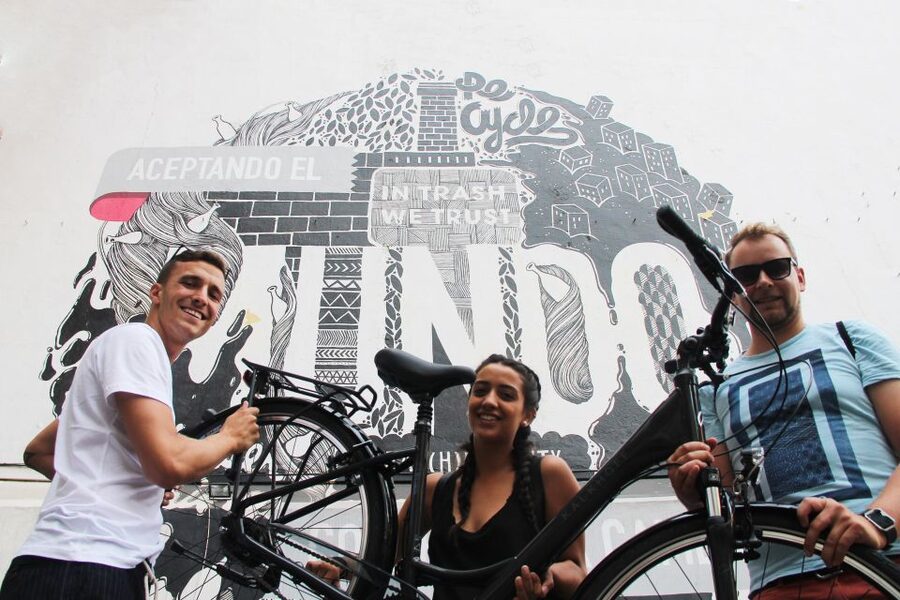
The ride then reaches Solar Antonio Grilo, a former neglected space transformed into a community-oriented urban garden with street art. This is a different kind of stop from the festival walls in Malasaña.
Here, the art is part of a larger local effort. You see how an unused or abandoned site can become a place for people, plants, and creative work. The tour uses these spaces to explain hybrid ways of organizing community projects, rather than presenting street art only as decoration.
That distinction adds real value. A mural at a festival may be designed to catch your eye for a season. A community garden has a job to do every day. It creates a meeting point and gives residents a role in shaping their surroundings. You get a better picture of Madrid when you see both types of urban art.
Solar Antonio Grilo is in the Noviciado area, and it fits naturally with the tour’s larger theme: Madrid’s creative life is not limited to major galleries. It also appears in leftover spaces, shared gardens, shutters, and walls that local people have claimed and improved.
Esto es una Plaza in Lavapiés
The route continues by bike to Esto es una Plaza, another community space in the Lavapiés and Noviciado area. Like Solar Antonio Grilo, it was once an abandoned place and later became a local project with gardens and street art.
You see how a small urban site can combine practical community use with visual expression. The name points to the basic idea of the place: an open neighborhood area shaped by the people who use it. The art here is not separate from the space. It helps give the garden a character and makes the project easier to recognize.
This is one of the strongest parts of the ride if you want to understand Madrid beyond its grand boulevards. Lavapiés has a different feel from Malasaña, and the route shows how street art changes with its surroundings. The tour is not only about spotting famous names. It is also about seeing how local groups use art to mark, improve, and share a part of the city.
You may see work connected with artists such as El Rey de la Ruina, Cassassola, Ze Carrión, and Por Favor. The exact pieces available can change, which is normal for outdoor art. Think of the tour as a guided look at Madrid’s changing walls rather than a guaranteed museum collection.
Same city, a different set of walls:
- Madrid: Street Art Tour with Local Graffiti Hunter
★ 4.8 · 270 reviews - Street Art Guided Tour in Madrid
★ 5.0 · 175 reviews - Barcelona Street Art Tour with Exclusive Artist Studios Visit
★ 5.0 · 152 reviews - Raval Street Art and Graffiti Guided Tour in Barcelona
★ 5.0 · 81 reviews
The Artists and Techniques Behind the Walls
A major strength of this experience is the guide’s connection to graffiti. You are not simply cycling from one photo stop to another. You learn why artists choose certain surfaces and how they work with the limits of the city.
The guide discusses methods used on walls, metal shutters, and other urban elements. That can change the way you see Madrid after the tour. A closed shop is no longer just a closed shop if its shutter has been used as a canvas. A traffic post can become part of a festival installation. An abandoned lot can shift into a community garden with its own visual language.
The guide is offered in English or Spanish. Javier led one family group and was praised for combining the art with less obvious parts of Madrid. That matters because the best version of this tour is not only a lesson about artists. It is also a ride through neighborhoods where the urban character is easy to miss if you stay on the main sightseeing routes.
The tour has worked for a family with a seven-year-old riding independently, but that does not mean every child will find it easy. Your child needs to control a bicycle in city conditions, and you should consider the traffic and uphill section before booking.
How Hard Is the Cycling?
The practical information describes the activity as medium level, with one uphill stretch. The advertised duration is 2.5 hours, while the important information also refers to a three-hour medium-level activity. Because those details differ, check the current starting time and duration when you reserve.
The ride is suitable for you if you are comfortable cycling in an urban area. You should be able to start and stop without trouble, follow the guide, and remain alert when streets become busy. Comfortable shoes are recommended, and you should bring a passport or identity card.
The bicycle, helmet, and lock are included. A restroom break is also included, which is useful during a ride of this length. Beverages are not included, so plan to buy your own if needed.
One rider found that people below average in cycling ability had difficulty with Madrid traffic and the uphill portions. That is the clearest warning to take seriously. The guide adjusted the ride where possible, but no guide can remove every city-cycling challenge.
Is $46 a Fair Price?
At $46 per person, the price is reasonable if you want several things combined: a rental bike, safety equipment, a guide with a graffiti background, neighborhood touring, and an introduction to Madrid’s street-art history.
You are not paying only for transport between murals. The price includes interpretation, route planning, and access to a set of places that would be difficult to connect efficiently on your own. The Madrid city map is a small but useful extra, especially if you want to return to Malasaña or Lavapiés later.
The value is strongest for first-time visitors who want an alternative to Madrid’s major museums and royal sights. It is also useful early in your stay, since the route can help you get your bearings in several central neighborhoods. If you already know the city well and only want a long, leisurely bike ride, the street-art focus may be less important to you.
You can cancel up to 24 hours before the activity for a full refund, and you can reserve without paying at the time of booking. Those options help if your Madrid schedule is still changing.
Meeting at C/Montera 32
The tour begins at the entrance to the small Carrefour Express at C/Montera 32. The nearest metro stations are Gran Vía and Sol.
This is a central meeting point, but give yourself enough time to find the correct entrance. The activity ends back at the same location, which keeps the logistics simple. You do not need to arrange a separate return journey from another neighborhood.
The included city map can help after the tour, but do not rely on it as your only navigation plan before meeting the guide. Check the precise starting time when booking, since several starting times may be available.
Who Will Get the Most from This Ride?
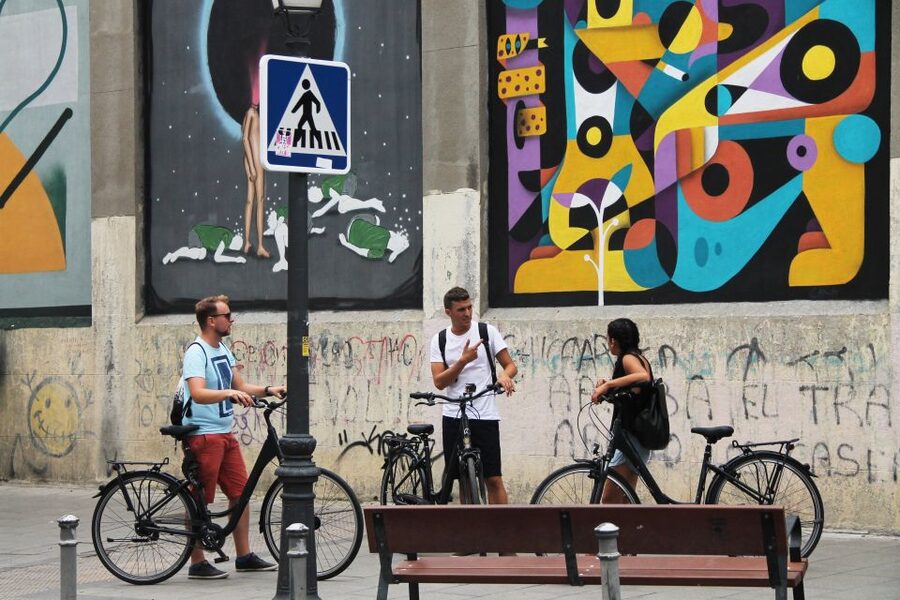
I would choose this tour for you if you want to connect Madrid’s visual culture with its neighborhoods. It suits visitors who like contemporary art, local projects, photography, and guided city rides more than a fixed museum visit.
It is also a good fit for families with children who can ride independently and safely in town. The seven-year-old example shows that young riders can take part, but age alone is not enough. Cycling confidence matters more.
You may want a different activity if you dislike traffic, struggle on an uphill route, or prefer to spend a long time at each work. The tour covers several areas in a limited time, so its strength is the route and the guide’s explanation rather than extended study of each mural.
Should You Book the Madrid Street Art Bike Tour?
Book it if you want to see Malasaña and Lavapiés through their street art, learn from a working graffiti artist, and understand how festival murals connect with community spaces. The best moments are the preserved Muelle tag, the Pinta Malasaña work around Plaza Dos de Mayo, and the contrast between large artist projects and gardens built by local communities.
Skip it if you are not comfortable cycling in traffic. If you do book, wear comfortable shoes, arrive ready to ride, and tell the guide early if you need a gentler pace. At $46, it offers solid value for an active, art-focused introduction to central Madrid, provided the cycling level suits you.
FAQ
Where does the Madrid Street Art Bike Tour begin?
It begins at the entrance of the small Carrefour Express at C/Montera 32. The nearest metro stations are Gran Vía and Sol.
Where does the tour end?
The activity ends back at the same meeting point on C/Montera 32.
How long does the bike tour last?
The tour is advertised as 2.5 hours. The additional information describes it as a three-hour medium-level activity, so check the current duration when you book.
Is the tour available in English?
Yes. The live guide is available in English or Spanish.
What is included in the price?
Bike rental, a helmet, a lock, a Madrid city map, a live guide, and a restroom break are included. Beverages are not included.
What should I bring?
Bring a passport or identity card and comfortable shoes. You should also be prepared for city cycling, traffic, and one uphill section.
New street art tours in Spain
- Small-Group Graffiti Tour and Workshop in El Carmen★ 5.0 · 2 reviews
- Bilbao Urban and Street Art Walking Tour★ 5.0 · 2 reviews
- Barcelona Street Art, Graffiti and Tapas Tour★ 4.0 · 5 reviews
- Salamanca: Private Guided Street Art Walking Tour★ 5.0 · 2 reviews
- Private Barcelona Street Art Tour★ 5.0 · 2 reviews
- Barcelona | StreetArt Bike Tour Moco Museum★ 4.6 · 13 reviews
- Madrid Street Art Tour (Malasaña Chueca Gran Via & Lavapies)★ 3.5 · 8 reviews
- Málaga: Street Art Tour in the Soho District★ 5.0 · 4 reviews
Street Art Bike Tours, side by side.
London Bike Tour: Landmarks, Secret Gems, Pub Stop & Street Art
Read our review →
Barcelona Street Art and Graffitti Bicycle Tour
Read our review →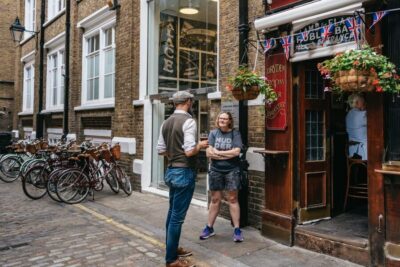
Landmarks & Secrets Bike Tour with Pub & Street Art
Read our review →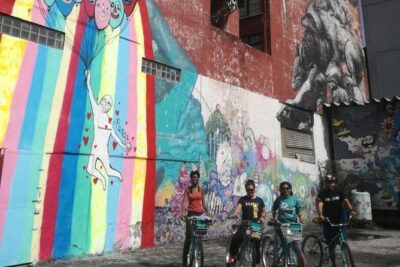
Mexico City; ART NACO : Murals & Street Art Bike Tour
Read our review →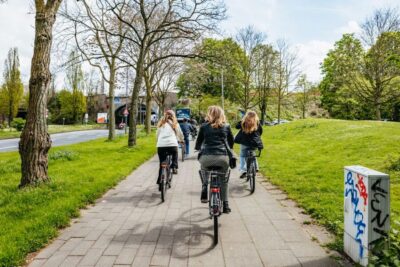
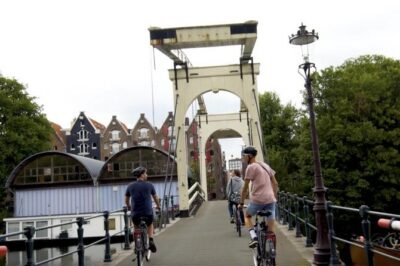
Urban Adventures Amsterdam Bike Tour, Graffiti and Magnet Fishing
Read our review →
E-Bike Guided Tour Downtown St Pete: Sights & Murals
Read our review →Lists this wall walk turns up in