
Reviewed · STREET ART WALKING TOURS
Naples Spanish Quarters Walking Tour Street Art, Folklore & Sweet
The most memorable part of this Naples walk is not simply the murals. It is the chance to see how the Spanish Quarters still function as a neighborhood, with people greeting the guide, children and families shaping the streets, and old stories sitting beside modern street art. Guides such as Serena, Simone, Arianna, Roberta, and Davide bring different local voices to the route.
I like the small group limit of 15 and the modest price of $14.74. I also like the mix of history, football culture, folklore, and sweets, since it gives you more than a quick photo stop. The main drawback is that the street art portion can feel limited if you expect a broad survey of Naples’ murals, and meeting-point confusion has caused trouble for some participants.
Key points before you book
- The Spanish Quarters are the main event: Expect narrow lanes, old buildings, local stories, and daily life rather than a citywide art tour.
- Local guides make the difference: Serena, Simone, Arianna, Roberta, Davide, and others have been praised for their warmth, storytelling, and connection to the neighborhood.
- Street art has a social purpose: Your guide may explain projects aimed at giving young people fresh options and a stronger sense of place.
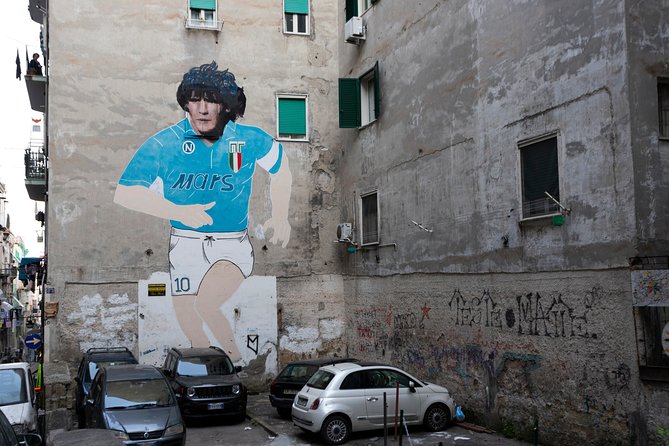
- Maradona is part of Naples’ identity: Football stories often appear alongside art, history, and neighborhood folklore.
- You finish where you start: The walk begins at Galleria Umberto I and returns to the same meeting point.
- The price is easy on the budget: At $14.74, this is a low-cost way to spend two hours with a guide, visual material, and a taste of local sweets.
Why the Spanish Quarters feel different from central Naples
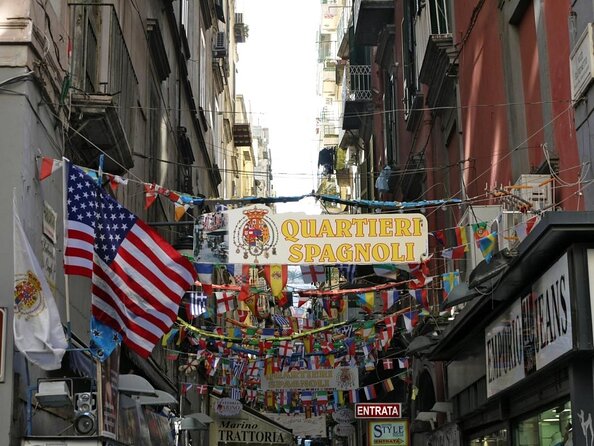
The Quartieri Spagnoli sit in the heart of Naples, spread through the San Ferdinando, Avvocata, and Montecalvario districts. Their narrow streets were laid out in the 16th century under Spanish viceroy Pedro de Toledo, first to house Spanish military troops.
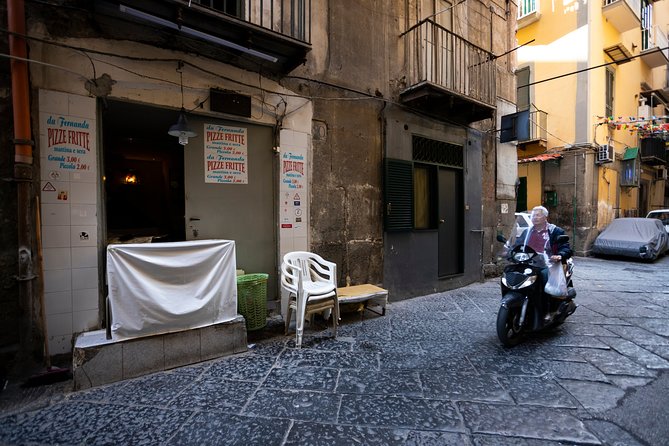
That original plan still shapes your walk. Streets run in a fairly regular grid down from Castel Sant’Elmo, but the effect at street level is less formal. You get tight lanes, tall buildings, balconies, laundry, small businesses, shrines, murals, and sudden glimpses of ordinary life.
I like this setting because the neighborhood is not presented as a polished open-air museum. It has contradictions. Its past includes military control and marginalization, while its present includes local pride, art projects, football devotion, and strong community ties.
Your guide’s role matters here. A guide who grew up in the area can explain why a wall painting matters, who a local figure was, or how a street has changed. Several guides connected closely with residents, and one particularly personal account involved meeting older locals and Maria, a woman who shared photographs and stories through the window of her home.
That sort of encounter cannot be promised on every departure, but it shows what this tour can offer when the guide knows the people and the streets well.
More Street Art Walking Tours in Naples:
- Naples: Street Art, Wine and Food Tasting Walking Tour
★ 5.0 · 163 reviews - London: Street Art and Graffiti Guided Walking Tour
★ 4.9 · 1,354 reviews - Berlin: City Street Art Guided Walking Tour
★ 4.8 · 1,051 reviews
Starting at Galleria Umberto I
The official meeting point is Galleria Umberto I, at Piazzetta Matilde Serao 2. This grand 19th-century arcade is easy to recognize, but you should still check the exact meeting instructions before leaving for the tour.
Meeting-point problems have occurred, including confusion around Piazza Municipio and a pharmacy nearby. One participant missed the walk after the guide waited and returned to the area. The details suggest a practical lesson: arrive early, compare the address with your confirmation, and do not assume that a large square has only one possible meeting spot.
The tour is offered in English and usually keeps to a maximum of 15 people. That is a useful size for narrow lanes. You can hear a guide more easily than in a large walking group, and a small group is less intrusive in residential streets.
The activity lasts about two hours. It is a walking tour, so wear shoes that feel secure on uneven urban surfaces. The supplied information does not promise a particular route order or a fixed list of murals, so you should think of this as a guided neighborhood walk with street art, not a formal gallery visit.
Walking the Quartieri Spagnoli
The first main section focuses on the Spanish Quarters. Your guide explains how the area developed under Spanish rule and how its original purpose shaped the streets you see today.
The historical information is useful because the neighborhood can seem chaotic at first glance. The street grid, steep relationship to the hill, and close-packed buildings make more sense once you know how the quarter was planned. You are not just passing through random lanes. You are seeing an urban district built for a specific political and military purpose, then reshaped by generations of Neapolitan life.
The most praised guides make this history personal. Serena has been described as patient and open about life in Naples. Simone has been praised for bringing the area he grew up in to life. Arianna has been described as a passionate young historian, while Manuela was especially good at explaining how local people live and how she seemed to know people on every corner.
Those differences matter. A good guide can turn a wall, doorway, or small square into a story about work, family, migration, football, or social change. Without that context, the Spanish Quarters can look like a photogenic maze. With it, the streets become easier to read.
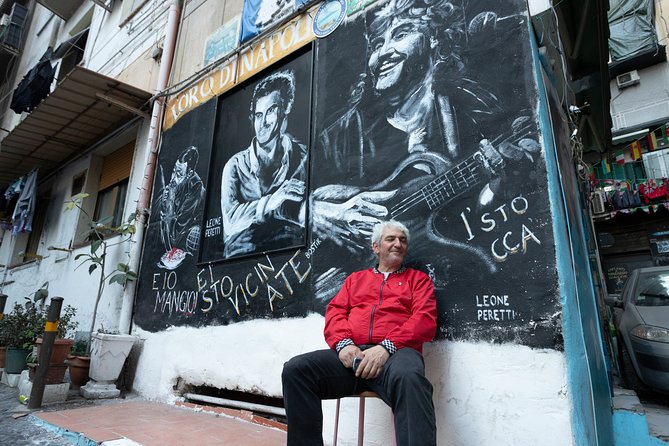
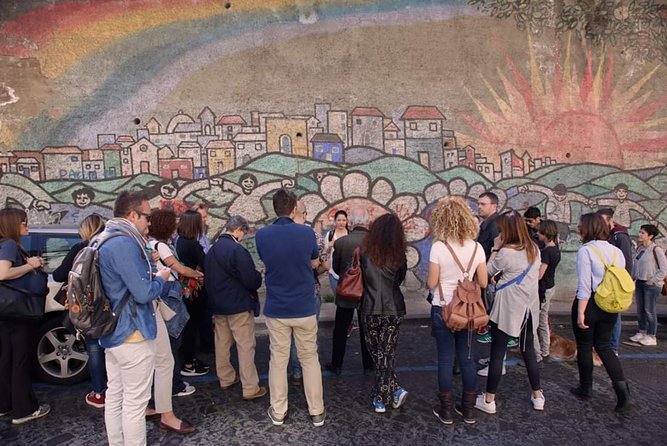
You may also hear about street art projects that work with young people. Here, art is not only decoration. It can offer a public voice, preserve local memory, and encourage different choices for people growing up in the neighborhood.
Street art with a local point of view
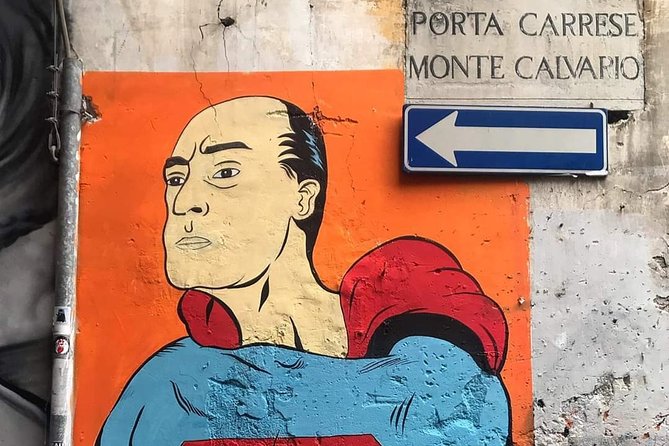
The title promises street art, but you should set your expectations correctly. This is not a tour of every major mural in Naples, and the art may feel concentrated in the Spanish Quarters rather than spread across the old city.
One participant found the street art disappointing and felt that some pieces passed without enough explanation. Another felt the description suggested a wider range of artwork in the historic center. That is the clearest limitation of the experience.
I would book this tour for the stories around the art, not for the largest possible collection of murals. Your guide may explain the historical or social message behind selected works, and the visual material included with the tour can help put them in context.
The best moments come when the art connects to the district. A mural can point toward local memory, neighborhood pride, youth programs, or Naples’ football culture. It is more useful to ask what the painting means here than to judge it as an isolated piece of art.
Guides also bring different strengths. Antonio has been praised for explaining murals and their social setting clearly. Davide has been described as both well informed and entertaining. Miri and Miriam have been singled out for strong local knowledge, while Roberta has been praised for patience and care.
The experience may therefore vary by guide. That is common with a neighborhood walk, especially one built around conversation rather than a fixed museum collection.
More street art tours worth booking in Naples:
- Naples: Spanish Quarters Folk Street Art w/ Sweets Tasting
★ 4.9 · 788 reviews - Naples Essentials: Monuments, Local Life & Street Art
★ 4.9 · 79 reviews - Rione Sanità tour among baroque, revival, street art & food
★ 4.8 · 59 reviews - Naples: The Spanish Quarters, Street Art and Local Market
★ 4.7 · 59 reviews
Via Toledo and the wider historical setting
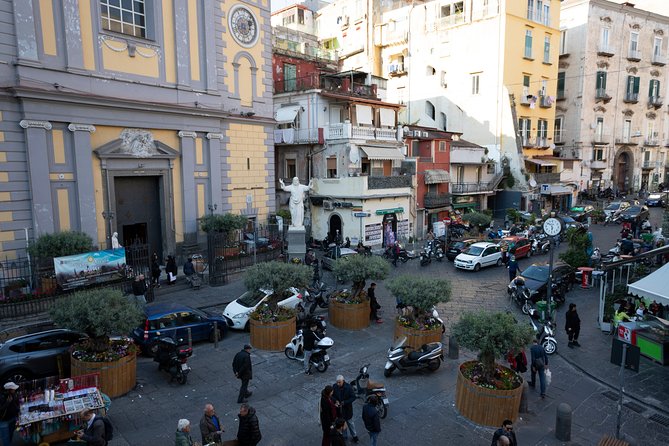
The route also includes Via Toledo, one of Naples’ major streets. Commissioned in 1536 by Pedro Álvarez de Toledo, it runs between Piazza Dante and Piazza Trieste e Trento.
The street was created as Naples expanded under Spanish rule. It once ran beside city walls that later disappeared as the city grew. Today, Via Toledo links historic buildings, churches, piazzas, shops, and the constant movement of central Naples.
This section helps connect the Spanish Quarters to the larger city. The lanes of Montecalvario can feel intensely local, while Via Toledo shows how the area fits into Naples’ main urban spine. You get a sense of how power, commerce, religion, and everyday life have shared the same streets for centuries.
Still, you should not expect a long independent tour of Via Toledo. The supplied route gives the Spanish Quarters the main emphasis, and the street may function more as part of the walk than as a separate historical lecture.
Folklore, Maradona, and everyday Naples
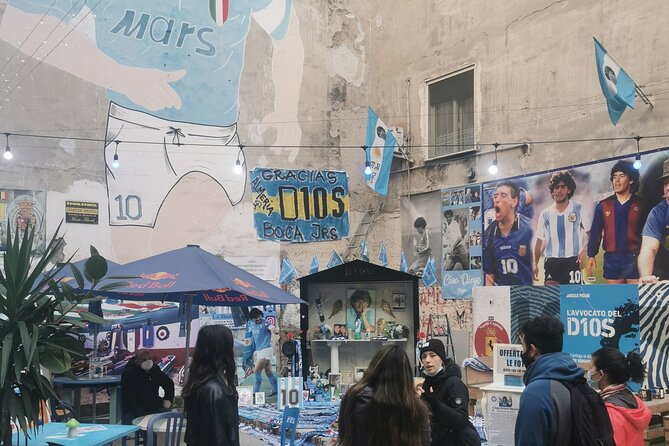
The tour’s strongest feature is its range. In two hours, you may hear about the origins of the neighborhood, local customs, street art, football, and ordinary residents.
Maradona often appears in the storytelling. In Naples, his name is not merely a sports reference. It is tied to local pride and the city’s sense of identity. Including him gives the tour a modern cultural thread, especially for anyone who wants to understand why football matters so much here.
The folklore side also helps. You are not only learning dates and architecture. You are getting stories about how people use their streets, how neighbors know one another, and how a district once seen as troubled has worked to express its own identity.
One of the most compelling accounts involved a guide who was greeted warmly by people along the route. An older group of men welcomed the visitors, and Maria shared memories and photographs from her life after the war. That kind of contact depends on timing and local relationships, so it is not guaranteed, but it shows the value of a guide with genuine ties to the area.
You should also allow room for the unexpected. One guide cared for a participant who became ill, while another adapted between Italian and English when the expected English-speaking guide was unavailable. These details suggest a tour that can feel personal, though they also show why your exact experience depends on the individual guide and the day’s conditions.
The Neapolitan sweet at the end
The tour includes a typical taste of Neapolitan sweets. The information does not identify the specific sweet or promise a full food stop, so treat this as a small tasting rather than a meal.
That modest snack fits the tour well. Naples is best understood through ordinary pleasures as much as through grand monuments, and a local sweet gives the walk a simple sensory finish.
Food and drinks beyond the included taste are not covered. If you want a full meal, coffee, or more desserts afterward, plan and pay for those separately. Guides may also offer suggestions for pizza or other places to eat. Miriam, for example, has been praised for recommending a pizza spot after the walk.
Is $14.74 good value?
At $14.74 per person, this is inexpensive for a two-hour guided walk in central Naples. The fee includes the guide, street art focus, visual material, and a small sweet tasting. For a first day in the city, it can be a practical way to get local orientation without spending much.
The value depends on what you want. If you want a formal art tour with a large number of major murals, the price may reflect the simpler product. If you want local stories, a compact introduction to the Spanish Quarters, and a chance to ask questions, the cost is very reasonable.
The small group cap also helps. A group of up to 15 is not private, but it is manageable in narrow streets and gives you a better chance to hear the guide. Group discounts are available, which may make the activity even more appealing for families or friends traveling together.
The tour is also popular enough that it is often reserved around 18 days ahead. That does not mean every departure sells out, but it is sensible to reserve early if your schedule is tight.
Practical details that can affect your day
The walk starts and ends at Galleria Umberto I. Since the return is to the meeting point, it is easy to connect with another central Naples plan afterward, provided you allow a little time for the tour to run long.
Most people can participate, and service animals are allowed. The activity is near public transportation. The route moves through busy historic streets, so you should be comfortable walking for about two hours and staying with the group.
Confirmation is provided at booking. Free cancellation is available if you cancel at least 24 hours before the local start time. Changes or cancellations inside that window are not accepted for a refund.
The biggest practical warning is the meeting point. Piazza Municipio is a large area, and the guide may not be standing where you first expect. Use the exact address, arrive early, and contact the operator promptly if anything looks unclear.
Who should book this walk?
I would choose this experience if you want a human introduction to Naples rather than a list of monuments. It suits first-time visitors, people interested in local life, and anyone who enjoys hearing how history continues to shape a neighborhood.
It is also a good fit if you want to understand the Spanish Quarters before exploring them alone. The guide can give you useful context for the street layout, murals, football references, and local customs.
You may want another activity instead if your main goal is a major street-art route across all of Naples. The art selection can be limited, and some pieces may receive only brief explanation. The walk is strongest as a neighborhood and culture tour with art woven through it.
Should you book the Naples Spanish Quarters Walking Tour?
At $14.74, I think this is a smart, low-risk addition to a Naples visit. Book it for the local stories, guide personality, neighborhood access, and mix of history with modern identity. Serena, Simone, Arianna, Roberta, Davide, Antonio, and the other guides each appear to bring a personal approach, and that human connection is the heart of the experience.
Go in expecting a lively two-hour walk, not a full survey of Naples street art. Confirm the meeting point carefully, arrive early, and leave room for the route to surprise you. If you want to see how Naples’ Spanish Quarters work as a real community, this tour is worth the time.
FAQ
How long does the walking tour last?
The tour lasts approximately two hours.
Where does the tour begin?
It begins at Galleria Umberto I, Piazzetta Matilde Serao 2, 80132 Naples, Italy.
Where does the tour finish?
The activity ends back at the meeting point.
Is the tour offered in English?
Yes. The tour is offered in English.
How many people can join the group?
The maximum group size is 15 participants.
What does the tour include?
It includes a guide, an open street art museum experience, visual material, and a typical taste of Neapolitan sweets.
Are food and drinks included?
Food and drinks are not included beyond the stated taste of a typical Neapolitan sweet.
Can I cancel for a refund?
Yes. You can cancel at least 24 hours before the experience start time for a full refund. Cancellations or changes made less than 24 hours before the start time are not accepted for a refund.
New street art tours in Naples
- Street Art of Spanish Quarters and Maradona Tour★ 3.5 · 3 reviews
- The Spanish Quarters, Street Art and Local Market Tour in Naples★ 5.0 · 23 reviews
- Naples Murals Catacombs and Folklore Sanità District Tour★ 4.5 · 5 reviews
- Rione Sanità: tour among street art, architecture, folklore★ 4.5 · 2 reviews
- Naples Walking Food Tour: Street Food and Maradona Murales★ 3.1 · 4 reviews
- Naples: Football Tour with Maradona Stadium & Mural★ 4.4 · 5 reviews
- Naples : Spanish Quarter & Maradona Street Art Tour★ 4.8 · 5 reviews
- Rione Sanità Street Art and Traditions Tour for Small Groups★ 5.0 · 27 reviews
Street Art Walking Tours, side by side.


Brooklyn Graffiti & Street Art Walking Tour in Bushwick
Read our review →

Street Art and Underground Movements Walking Tour
Read our review →Lists this wall walk turns up in